


















On the Minutiae of Oakum & the Hokum of Growing Up Wild
Discover the lost art of caulking from an old shipyard mentor. Learn about traditional marine craftsmanship, the tools of the trade, and the wisdom passed down through generations of seafarers.

As a young bilge rat who was often cast loose (by busy parents) in shipyards from the Midwest to Key West, I had a plan. It wasn’t a good plan, but I didn’t know that because I was so young. There’s always a Catch-22, isn’t there? Regardless, everyone in the shipyards was dirt poor. I decided to be wealthy when (and if) I grew up. Simple, right?
My mentor had a red nose, a deep cough, and, when drunk, a black heart. His name was Maynard and he reeked of rum and unfocused outrage. He’d been born in Canada but moved to Thomason, Maine, where he’d apprenticed at a young age. And now, in his dotage, he was an itinerant caulker.
Back in the day, things were simpler. What you saw was what you got. Nobody in a shipyard tried to “fake it until they could make it.” You judged a man in simple, direct, never-fail ways—starting with his callouses. Maynard passed. He had calluses on his palms that were the size of large grapes!

Conversely, we judged men without calluses as thieves. The only remaining question would be whether they robbed you with a gun or a fountain pen.)
Wayward sailors like Maynard, who were washed ashore in a bewildering world just beyond their backwater understanding, were common. In the wooden boat world of the ‘50s, many ‘freelance’ caulkers trudged from shipyard to shipyard.
What appealed to me about Maynard was that he carried everything he needed with him—an intriguing freedom, of sorts.
For this reason, I decided he was my path to riches—despite the fact that Maynard was always putting pieces of cardboard in the holey soles of his shoes.
…okay, so I wasn’t too bright.
Here’s the key to unlocking any heart—ask a question. Every question is, at its core, a compliment.
But first, I watched him, watched him intently.
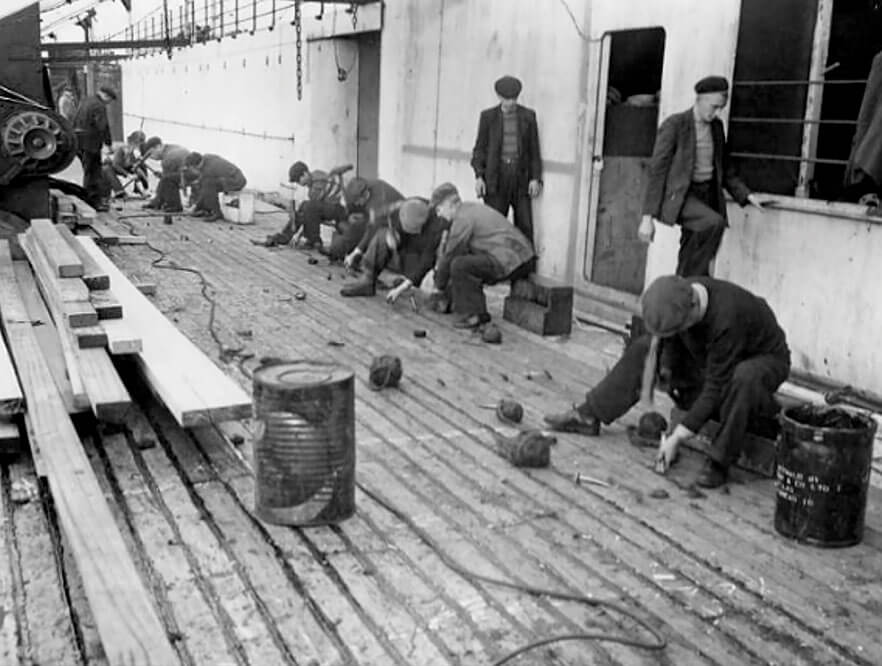
He’d roll the white cotton caulking in his palms before placing it in the seam while matching the width of the seam and the rolled, stretched, twisted strands. At the stem and at the garboard (the plank just above the keelson), he’d use the darker oakum, which was hemp-based and soaked in Stockholm Tar (as a preservative).
He primed the seam first with red lead—to both temporarily keep the caulking in place and preserved it as well.
The correct caulking iron was vital—it, too, depended on the width of the seam.

After about an hour of watching, I said, to break the ice so I could spring my conversational hook, my question, “I like your hammer.”
He looked at me. He stopped caulking. He grimaced. Then he shook his head and said with a dismissive wave, “Go play in traffic, kid.”
Now, I’ve already admitted I wasn’t the sharpest rigging knife in the ditty bag. But I made up for that shortcoming with tenacity. That’s the key to my life—to just keep hitting myself in the head long after others have stopped. The following day, shortly after he started to caulk, I sat next to him again.
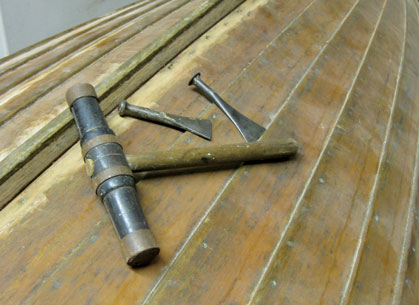
He didn’t look at me, just said testily, “It ain’t a hammer, son; it’s a mallet.”
It took me about half an hour to come up with a question that wouldn’t get me sent back into traffic. “Why does it look like that?”

“Why do you want to know?”
I shrugged.
He looked at me and I saw a tiny bit less disgust in his eyes. Progress, even slow progress, moves in the right direction.
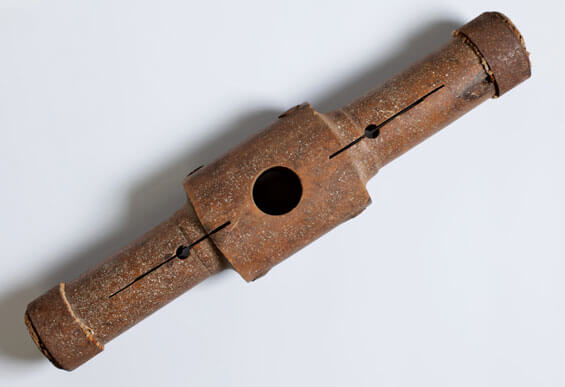
“One, the handle is removable so that it easily fits in the toolbox I carry,” he said, returning to the tapping of his mallet. “Two, the head of the mallet is made out of Black Locust, a hardwood. Three, the round metal ferrules can be moved as the striking surface wears. They help prevent the wood from splitting. Four, there’s a slit with a drilled hole in the top of the mallet that both reduces the noise and gives each mallet a distinctive ring. Oh, and the mallets come in different weights—say less than two pounds for small craft and closer to three pounds if you’re caulking ole Ironsides. And the mallets can be used vertically or upside down because getting in the right position is difficult while standing or sitting on scaffolding. You don’t have to swing a mallet hard, inertia does most of the work. A good mallet, with perfect balance, is a joy forever. Shipwrights pass them down, from grandfather to father to son.”
Well, well! He was a fountain of information—if handled correctly. I waited another hour, then asked, “What about the caulking irons—why so many?”
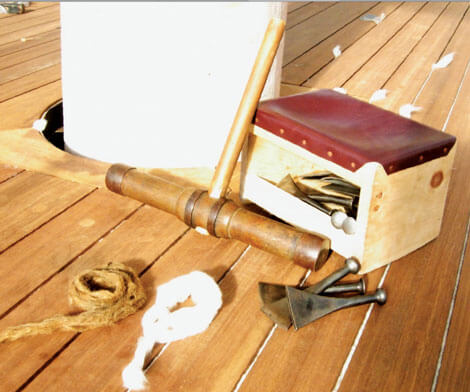
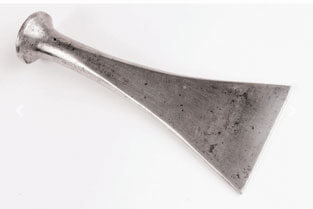
“Mostly I use straight-sided ones—except at the garboard, which might need widening. I caulk the bottom of the garboard first, then work my way down from the turn of the bilge to kinda squeeze that troublesome plank in place. Most of my irons are slightly rounded, so I can ‘rock’ them in place as I move down the seam. None of my irons are sharp. They’re blunt, with creases or hollow furrows at the ends to help bead the cotton in the seams. The irons come in different sizes, depending. I carry different seam rippers as well—but horse hoof-picks can be used in pinch. Some of my caulking irons are a quarter of an inch or wider. A few have two creases. You have to use the correct iron for the specific seam you’re caulking.”
“…the Devil to pay,” I mused, to show off. (Even as a child I was in love with nautical nomenclature.)
He looked at me with new respect.
“That’s right.” The garboard seam is the most difficult seam to keep watertight, devilishly so. Thus, the saying, the Devil to pay and, in relationship to drowning, between the Devil and the deep blue sea.
He smiled.
The smile told me that he was reconsidering—that, perhaps, I wasn’t the dumbest kid in America after all.
I watched him work. Company is company. Companionship is companionship—there’s no reason to allow clumsy words to ruin a budding friendship. About once an hour, he’d take a tiny sip from a pint of Screech Rum from Nova Scotia. (“It’ll make you screech, alright,” he once grinned to me. Yes, he had yellowed teeth; no, not too many.)
…but as sloppy as his life was, his work was immaculate.
He accommodated the widening and narrowing of the seam by increasing or decreasing his number of tucks of cotton, which is what regulates the final amount in the seam.
Maynard was lonely. He reeked of alcohol, despair, and banked anger. But suddenly he had someone listening to him; someone who realized his worth, no matter how minor that worth might be in the great scheme of things.
“Why, a bad caulker can almost ruin a boat,” he told me. “I’ve seen idiots pound the cotton all the way through the vessel—not only creating an eternal leaker but needlessly widening the seam at the same time. The idea isn’t to lay one strand on top of another strand, but rather to place a bead of tightly-packed, tightly-wound cotton three-quarters of the way in—at the flat section between the angled gap and the vessel’s interior. Thus, the cotton will swell as a single rope—not merely as loose strands.”
“How do you know if there’s enough or too little or too much cotton in the seam?” I asked.
“By sound,” he said. “With the right iron and mallet, each tap produces a slightly higher note as the bead tightens. I caulk like a piano tuner—too low means more cotton and harder taps. It’s simple but it takes experience; it takes judgment; it takes a caulker’s ear. Most kids today, they don’t give a damn. There’s no tradition anymore. And you know the worse part? When the boat is finally launched, and she doesn’t leak a drop—they pat the fat-cat designer and the rich builder on the back. But nobody pats my back. And I’m the guy that keeps the water out!”
A sense of injustice comes along with calluses—always has, always will.
Occasionally, usually on Friday afternoons, he’d get a real snootful of rum and go rampaging around the yard, picking fights and muttering risqué things to women who hurried by—and acting as a man does (or did, back in the day).
And shipyards are dangerous places. They’re littered with planks with nails sticking out and discarded frames with bronze screwheads as sharp as razors. Not to mention the broken glass, the giant splinters; the millions of places to twist an ankle or break a leg.
One day when I showed up, Maynard brought me over to an old yawl that had just been hauled out. The wood butchers (what shipwrights were called by their co-workers in the ‘50s) were removing a bunch of rotten planks to be replaced. Maynard squatted down at discarded sections of wood that weren’t too badly rotten and pointed at the plank edges.
“This boat was built in Huntington, Long Island. She’s air-dried mahogany over white oak. Note that she’s bronze fastened and her keel is lead, not cast iron. She’s topnotch all the way—and the way you can truly tell is right here.”
Maynard pointed at the plank edge again and said sternly, “Look, son; don’t glance.”
There was a rounded depression running the entire length of the plank, a rounded groove that appeared to have been carved into the edge of the plank with a router.
“So, during the construction,” I asked, “the shipwrights put that groove there to accommodate the caulking?”
“No,” Maynard said, “the caulker put it there. We didn’t have any chemical goop back then—the swelling cotton had to do 99% of the job itself. If the caulker did his job successfully, once launched the cotton and wood would both swell so tightly that they’d push an actual tunnel in the mahogany. That’s why, when I was a young man, a carvel planked boat wouldn’t hardly leak for the first ten or twelve years—until bits of her would go soft with age and rot.”
“No s*#t,” I said.
“Does your mother know you swear?”
“F#%k no,” I responded without a pause.
“…you’re a piece of work,” he laughed.
That was the closest thing I ever got to a compliment from Maynard.
And, thus, the summer rolled on.
Once he’d put his iron into the seam, he wouldn’t take it out during the final ‘choke.’
He’d get into a rhythm of rocking his caulking iron and tapping his mallet while moving down the seam—not fast but not slow either.
“Caulking is all about consistency and keeping the pressure in the seam even. Sure, the planks are fastened in place—but the swelling cotton plays a part, too. Carvel-planked wooden boats move—and the idea is to get the swelling planks and the swelling cotton to tighten like a drum to keep the water out.”
Once the seams were done, he’d hit them with a restless, never-stopping blow torch—to burn off any tiny protruding fibers that would wick water into cotton through the Woolsey seam compound.
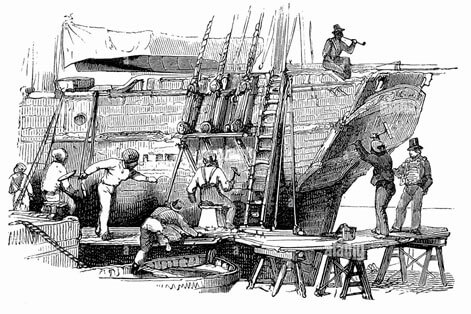
“If you’re using the right width caulking iron and it keeps sticking, dip it into linseed oil once in a while to prevent it from binding. Ditto, if your red-lead seam compound is too dry, just knead in a bit of thinner to soften it up. Oh, and I also dribble some antifouling into the seam compound below the waterline—that helps to keep the teredos away, at least for the first few years.”
I’d watch him force the stiff, sweet-smelling seam putty in with great pressure. The trick was not to trap any air inside the seam. It all looked simple at a lubber’s glance—but was far, far more complicated if you watched for an entire summer and continuously asked yourself, “Why? Why is he doing it that way and not another?”
“You know Morse code?” I asked him out of the blue.
He shook his head.
“How ‘bout celestial?”
…back in the day, there was no need to add the ‘navigation’ because, offshore at least, celestial was the only navigation there was.
On Friday afternoon, with a snootful, he fell off the scaffolding of the Burger motor yacht he was caulking—and clipped his head on something on the way down. The edge of a 55-gallon drum, maybe? Anyway, an ambulance took him to the hospital—and once someone was further than a block away in those days—well, they might as well be on Mars.
As I get older, I think of men like Maynard—the crude, violent, drunken men who taught me, however imperfectly, to be the man I am today. And I think about how taciturn and needy he was; how his gnarled fists looked while clutching the caulking iron, seemingly for dear life.
The best lesson that he taught me was that, indeed, there are real experts in life—and that gold is only one coin-of-the-realm to attract them; unspoken admiration works nearly as well.
By 12 years of age, I could copy & send Morse code at 15 words/minute—and was often complimented on my fist, my ability to tap-tap-tap out the letters clearly. My call sign was WN9NTY, Never Too Young.
And at 14 years old, I could swing a sextant—rocking the lower limb of the sun or a tiny winking star to dip it on the horizon like a pro.
And at fifteen, I recaulked my own yacht at Reikes Boat Yard—a cedar over oak, 1932 double-ender that eventually carried me away from America on all levels.
Maynard’s ghost sat scowling beside me on the scaffolding as I tap, tap, tapped.
Audacious? You bet. But I was utterly confident that I could earn my living as I circumnavigated the Seven Seas because the Holy Trinity of Marine Skills I had worked so hard to possess—tapping out Morse code on a Hallicrafter SX72 radio with glowing tubes, grabbing a quick star sight at dusk, or caulking a seam.
The result? Being nearly penniless my entire life.
Like I said, I wasn’t too bright back then—nor now, for that matter.
Cap'n Fatty Goodlander has written for ALL AT SEA since 2005.
Goes straight to Fatty. ALL AT SEA takes nothing.
Worth your time?
Thanks — noted.



Fatty – This is an excellent profound piece!