















How to Stop Your Boat from Rolling at Anchor: Effective Techniques
Tired of rolling at anchor? Learn how to stabilize your boat using flopper-stoppers, bridles, and stern anchors for a more comfortable stay.

Rock and roll!
Have you ever spent an extended period in an anchorage where swell enters? As long as the bow points into the waves there’s just some pitching, which is hardly noticeable, but as soon as the boats get beam-on to the waves, the movement becomes uncomfortable. The masts of monohulls start swaying like pendulum clocks, leaning over more and more as they get into their rhythm. Catamarans fare better and some cat owners will tell you that they don’t move at all, but watching them in the anchorage you’ll see that they might not roll, but instead they dance a jerky jig that can be quite annoying as well. Plates are sliding from tables, stuff gets catapulted from shelves, sleeping becomes impossible (at least in bed, a mattress on the floor is often more restful) and after a few days all crews get bleary-eyed and cranky. It’s high time to take measures against the rolling!
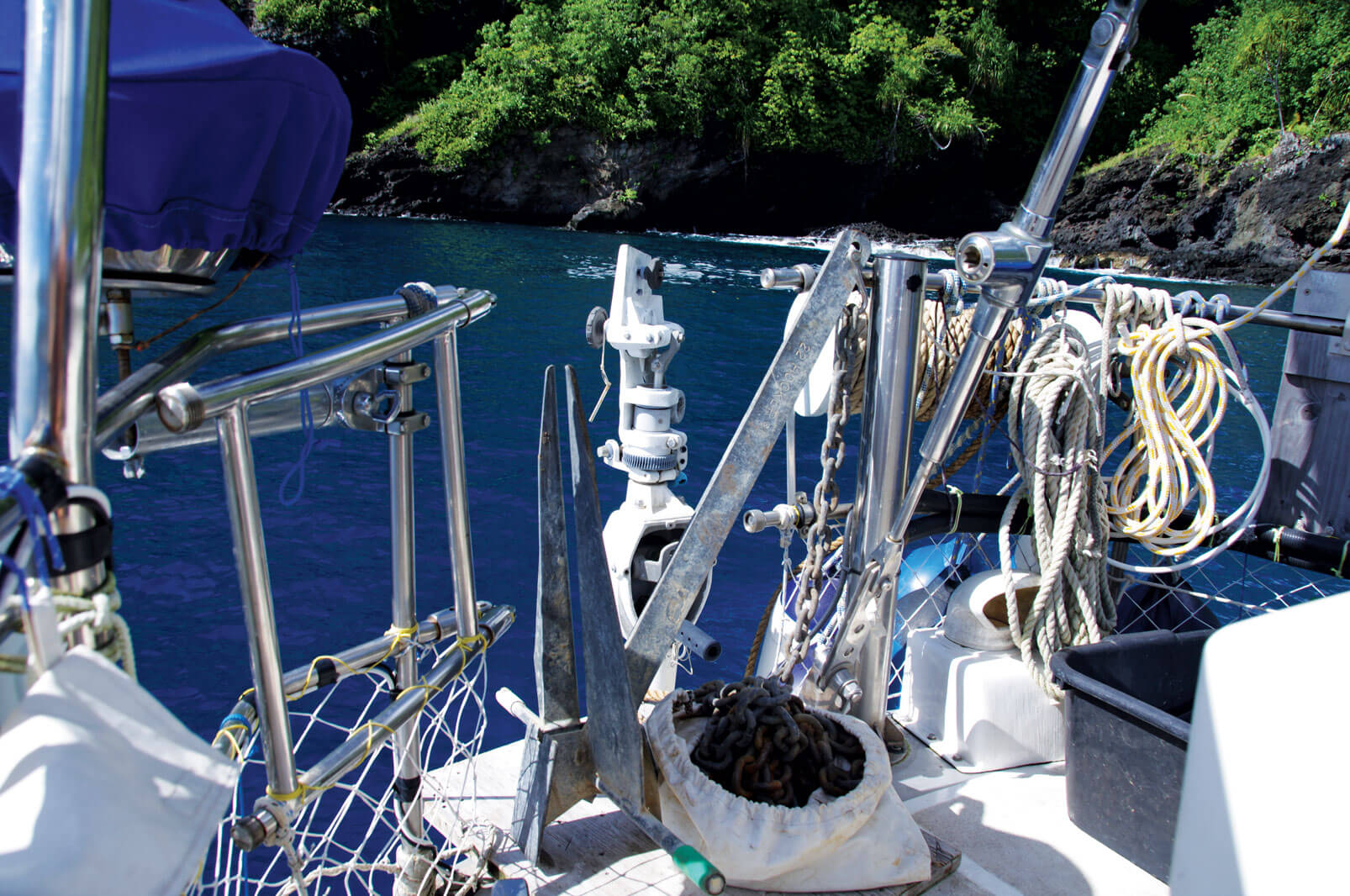
Deploying a flopper-stopper
In rolly places where people tend to linger for a while you will see a multitude of contraptions hanging from booms into the water that are meant to stabilize boats. Some are readily bought, others make-shifted, but most designs work on the same principle: boat rocking is damped by some sort of apparatus that is dragged up and down through the water, thus slowing down the motion. Desperate crews have spontaneously tried buckets or drogues, but if you are near a hardware store and have some tools, you may go for a more elaborate approach, cut a piece of plywood (square or triangular, opinions differ), weigh it down with some ballast, fiberglass over everything and start playing with line arrangements. The bigger the flopper-stopper the better it works, but then of course such a monster must be stored somewhere when it’s not in use.
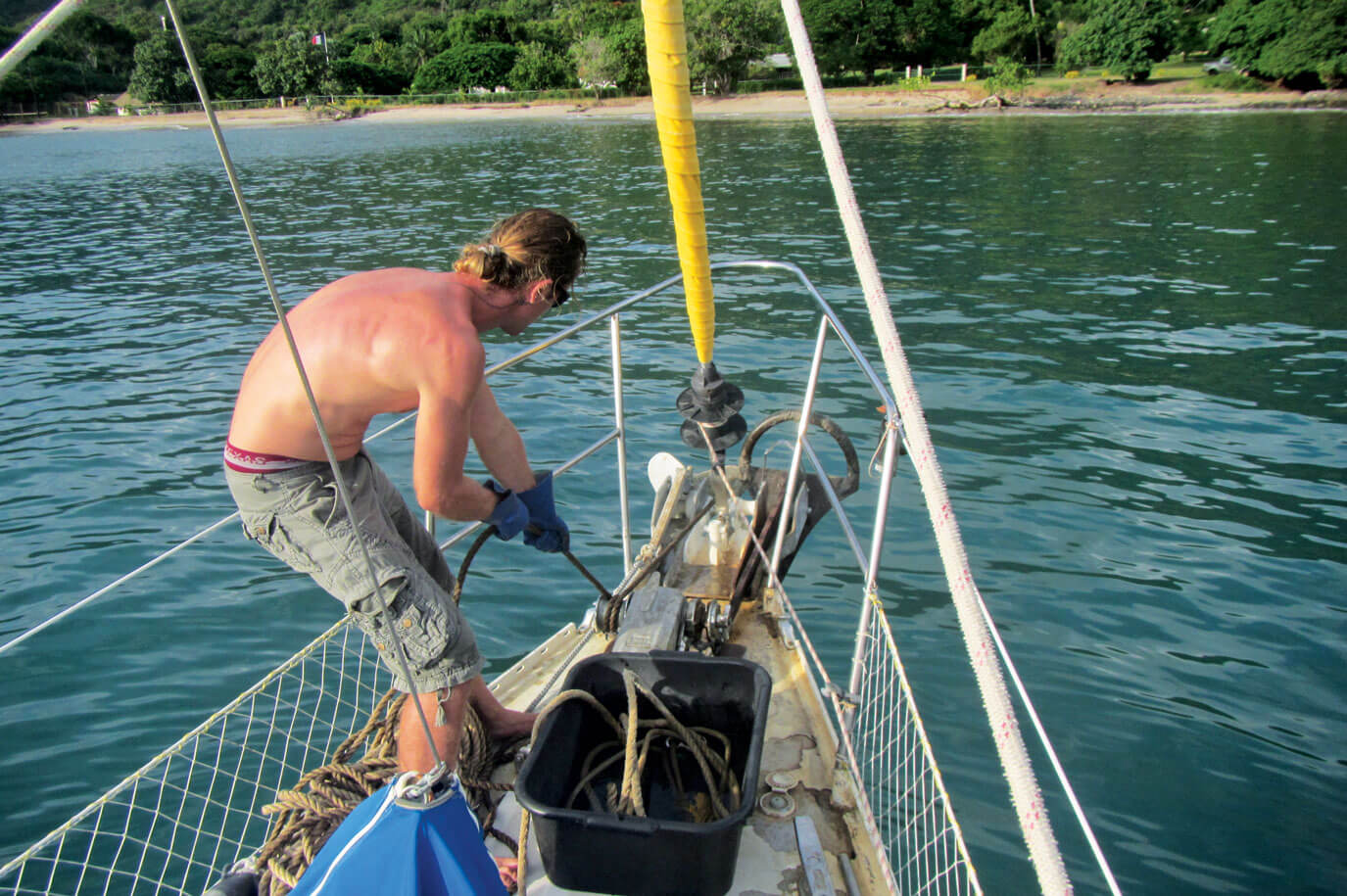
Rigging a bridle
In anchorages with a steady breeze, but swell entering from a different direction, you can try a method that requires less material and make-shifting, but also some playing with lines. First we tie a rope to the chain and lead this rope to a cleat amidships. Then we pay out more chain. Now it’s playtime: by adjusting the length of this bridle we can point the bow at different angles to the wind and try to align the boat with the waves. If the wind shifts, everything needs to be newly adjusted and if the breeze dies down completely (which unfortunately often happens at night), the bridle is of course rendered useless.

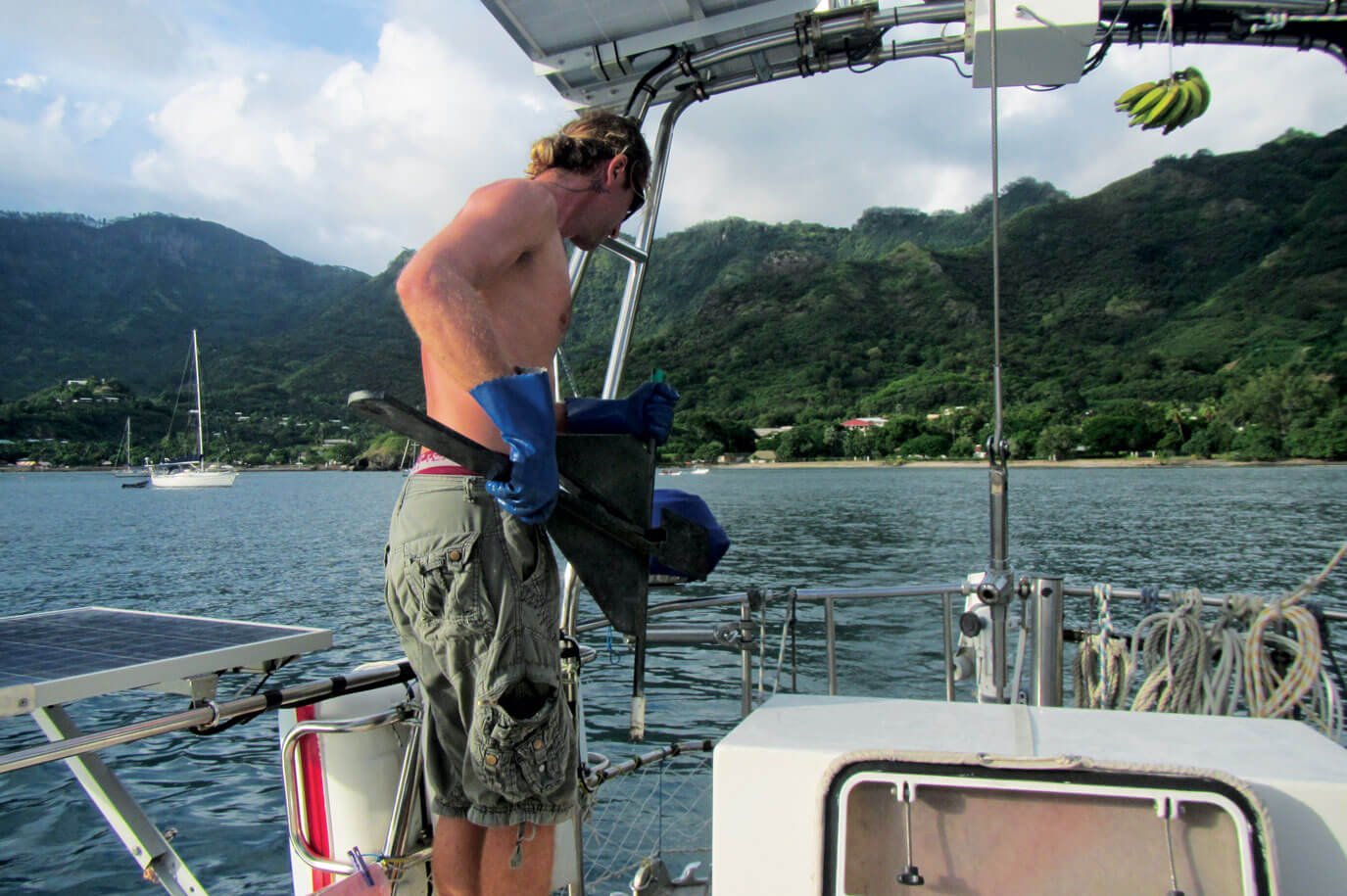
Setting a stern anchor
Whenever we are surfing down the swell as we are entering an anchorage we know the only way to prevent a sleepless night is setting a stern anchor. We used to anchor first and then get out the gear in order to bring it out by dinghy, but these maneuvers hardly ever worked. We never quite knew where the main anchor was, got the angle for the stern anchor wrong, had to pull it up and try again, resulting in frustration and arguments. After Christian pulled his back while retrieving the stern anchor in a deep anchorage, we decided to change our system: now we do just one maneuver, dropping first the bow anchor and then the stern anchor directly from the boat.
Christian unties our danforth anchor from the railing and gets out a 10 m piece of chain, followed by 50 metres of floating line. In the meantime I do a reconnaissance round to see which corner of the bay might be slightly calmer than the rest. Having found a spot, we drop the main anchor (tip: don’t forget to put a mark!), Christian pays out all our chain (60 metres) while I try to align Pitufa as good as it gets with the swell direction, taking into consideration wind direction and predicted wind shifts that might push the boat sideways. As soon as we agree that we are in place, Christian drops the danforth directly from the stern and then gets up chain from the main anchor to get tension into the system and hold us nicely aligned.
To retrieve the anchors we simply let the stern line go (it floats, a regular line will need a fender or other buoy to keep it up), lift the bow anchor and then return for the stern anchor, which is lifted over the bow as well.
With some practice this maneuver is quickly done and it certainly goes easier on the back than trying to deploy/lift a stern anchor by dinghy.
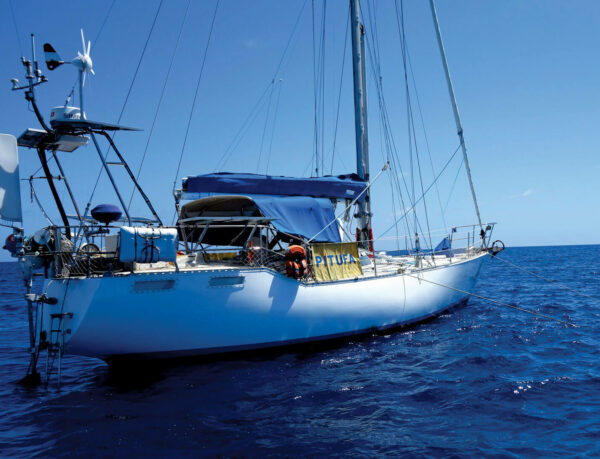
Birgit and Christian have been sailing and anchoring their 41 Sparkman & Stephens SY Pitufa around half the globe for 13 years. Find more tips and tricks on their blog www.pitufa.at or check out their books: “Sailing towards the Horizon” and “Cruising Know-How” are available on Amazon.
Birgit Hackl has written for ALL AT SEA since 2012.
Worth your time?
Thanks — noted.
