Crackling Connections: Troubleshooting Electrical Issues Aboard Your Boat
When your boat’s gadgets fail unexpectedly, it’s easy to panic and replace the wrong part. After 13 years aboard SY Pitufa, Birgit and Christian share hard-won lessons in boat electronics troubleshooting—from crackling speakers to dead winches—reminding us to check the cables before calling in a pro.

A few months ago the loudspeakers in “Pitufa’s” cockpit started crackling and failing—no more metal music for sundowners. We didn’t mind too much as the speakers were rather elderly already and moreover we had a visit to Europe scheduled. So we simply added another item to the already endless shopping list of spare parts and replacement items. Back on Pitufa we installed the shiny new speakers—and they were crackling just like the old ones. The fault was not with the speakers after all, but with the cable leading down to the amplifier. We could have kicked ourselves as we really should have known better from experience…

Don’t overreact, check first
The engine just goes “click” instead of “vroom” when you turn the key? The anchor winch suddenly doesn’t move even though it worked just fine yesterday? No more wind data coming from the instrument on the masthead? The batteries are strangely empty even though the sun is burning down on the solar panels? The light in the galley flickers and goes dark? We’ve experienced all these situations and many more similar ones during our 13 years living on Pitufa. In 95 % of all cases of spontaneous failure aboard the fault lies with a dodgy connection or cable.
So when some formerly reliable gadget on the boat fails, don’t call the mechanic or electrician in panic and don’t put a hasty order for a new part. Check the cables, terminals and relays first!

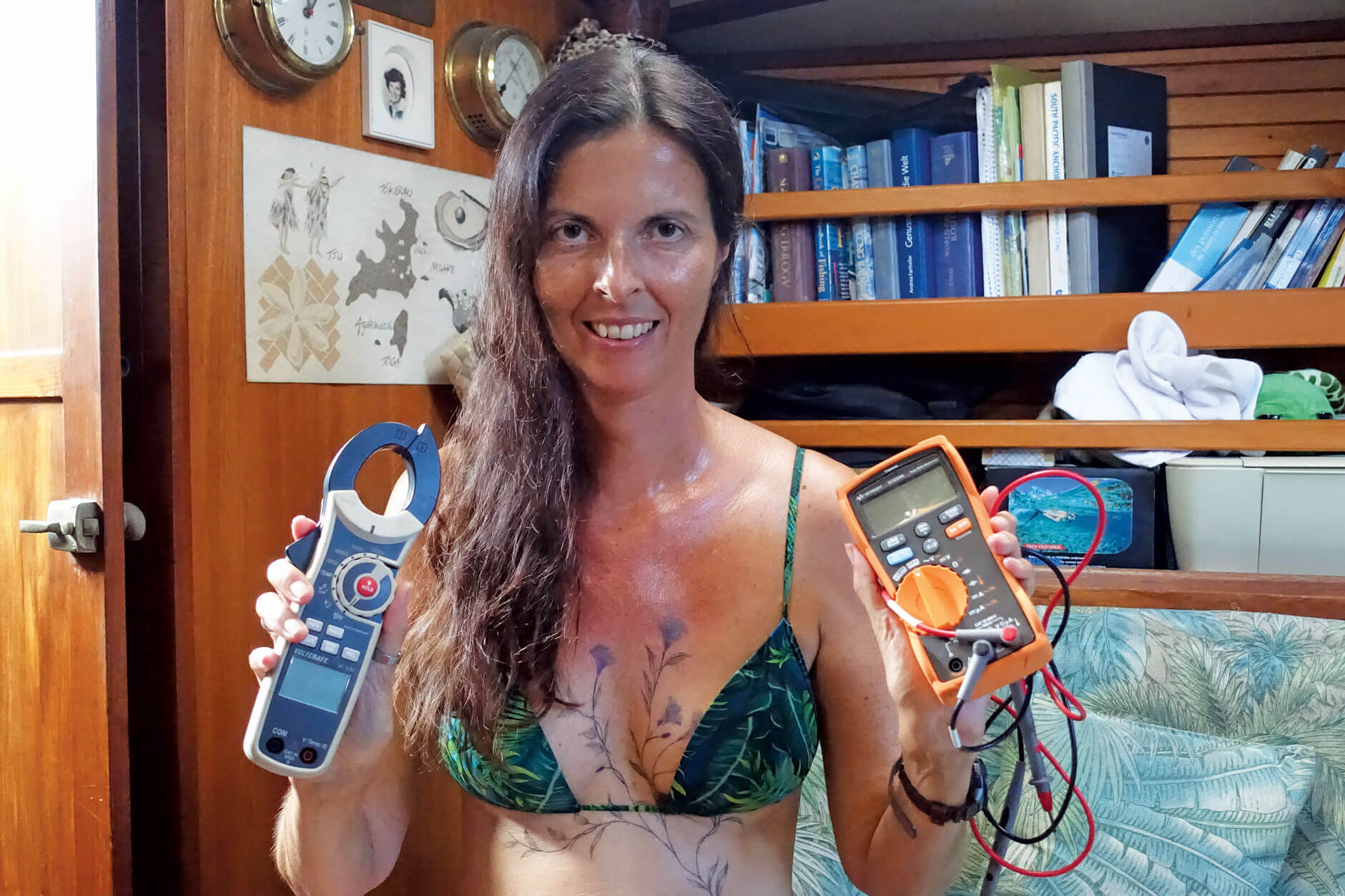
Multimeter versus clamp meter
A multimeter is your best friend in such situations and you don’t have to be an electrician to handle such a device. A clamp meter is even handier as it allows you to measure current without breaking the circuit. Even I as a complete layperson can thus follow the series of connections from its source to see how far the electric current actually reaches.
Careful: if you measure when the device is switched off you might overlook faulty areas as the voltage might look fine, but as soon as a load is switched on and current is running the voltage suddenly drops. So it’s sometimes advisable to measure voltage drops along a cable while the load is switched on.
To fix the faulty part some more expertise and equipment is needed, but if you lack this expertise (and don’t have an electrician as a partner like I luckily do) or the necessary replacement part, you can at least point the professional to the dodgy connection without having to watch him/her searching and sweating in unreachable corners of your boat while you’re paying a hefty price for each working hour.
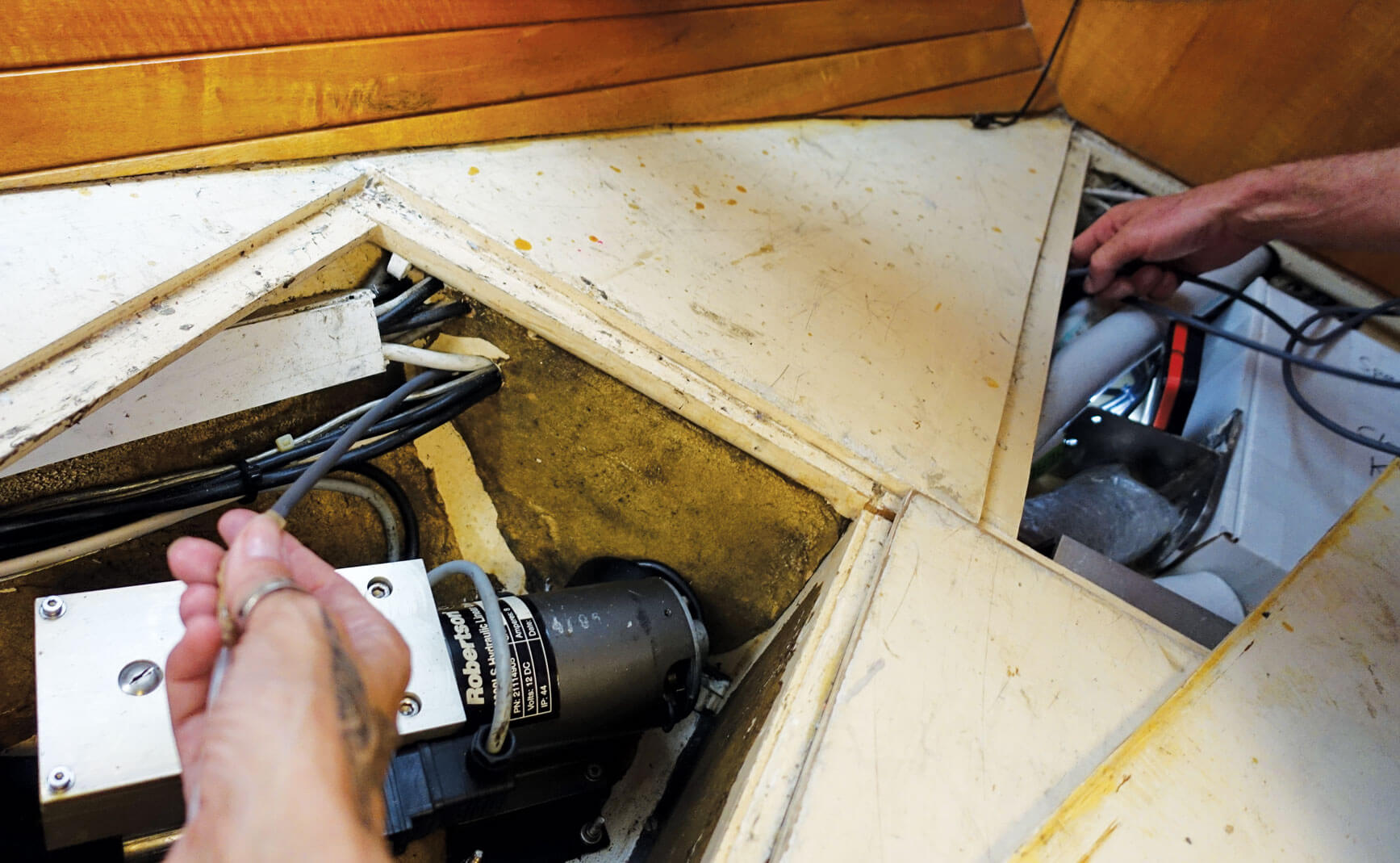
Overdimensioned, tinned cables in cable ducts
The marine environment gnaws relentlessly on all metal parts aboard. Most shipyards go for shiny aesthetics instead of practicality and think it’s cool to hide all “ugly” electrical installations behind paneling and insulation—often glued in and made for eternity, without any considerations for repairs, adjustments and additions that will be necessary during the long life-time of a boat. The previous owner of Pitufa had most electrical connections redone outside those panels and run in more easily reachable cable ducts. Well done in principle, but he then used bare copper cables that started corroding away soon after we had bought the boat. It really pays off to invest in tinned cables whenever you do a new installation as bare copper does not stand a chance. If you’ve inherited regular landlubber copper cables from the previous owner like we did, it may pay off in the long run to bite the bullet and install everything new while you’re still in a place with well-stocked hardware stores and plenty of professionals around.
Excessive voltage drops while measuring shouldn’t be ignored as they might indicate a dodgy connection or that the chosen cable diameter was not adequate right from the start. Everything to do with batteries, chargers, windlass, watermaker, solar panels and inverter should be overdimensioned—don’t be stingy with thin cables wherever high currents are running.
Gadgets coming off and on
Even more annoying than a complete failure, are devices that unexpectedly fail (usually when they are really needed, like a wind instrument on a long passage) and then just as unpredictably and inexplicably bounce back and resume their work just as if they had never deserted you in the first place. To find the faulty connection you need to follow the cable and wiggle and pull relentlessly as dodgy bits can be hiding everywhere. When the starter of our Yanmar failed, it turned out that the end of the cable was rusted through and the crimped on eye-terminal was only held in place by the heat-shrinked tube—everything looked peachy from the outside and the tube didn’t even give way when pulled. Only when we cut it off, we found the damage underneath…
Birgit and Christian have been sailing and repairing their S&S 41 SY Pitufa half around the world for 13 years. Check out their blog www.pitufa.at for more info or read their books “Sailing Towards the Horizon” and “Cruising Know-How”–both available on Amazon.
Birgit Hackl has written for ALL AT SEA since 2012.
Worth your time?
Thanks — noted.