






The Hysterical History of Yacht Design
Since I’m a sailor who understands little about the larger picture of life, the universe, and everything, I usually limit my mental musings to things nautical.

I’m fascinated by humanity’s mistakes—perhaps because I’m so good at making mistakes myself. Since I’m a sailor who understands little about the larger picture of life, the universe, and everything, I usually limit my mental musings to things nautical. Why? Because most readers don’t know their port from their starboard.
Huh?
Okay, we’ll start there.
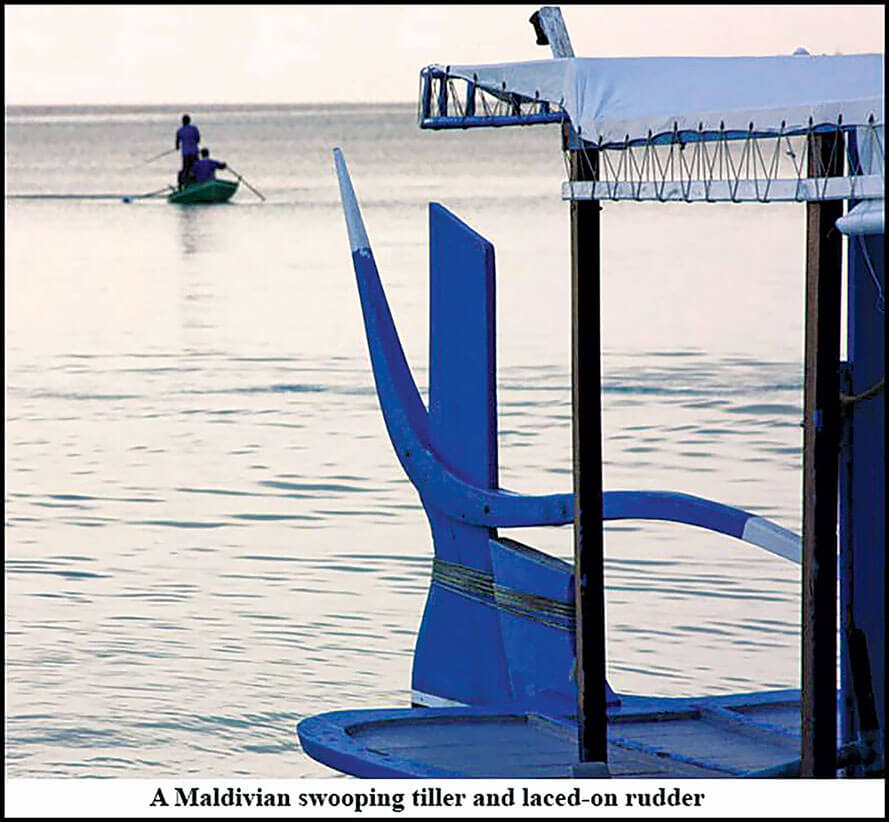
Rudders are Johnny-come-lately items on the marine scene. Primitive dugout canoes didn’t need rudders. The rower just switched his paddle to the other side of the canoe if he wanted to arc in one direction or the other.
And this method of steering was acceptable at first. A cave dweller would leave his cave, stomp to the beach, launch his canoe, paddle out to fish, catch a few, row back to the beach, drag his boat above the high tide line—then return to the cave to slap around his wife.
… all good.
Well, okay, not perfect.
But as the number of abusers and canoes increased, more potential accidents occurred. Even the dumbest rower realized that his paddle could be used to avoid collision as well as for propulsion.
As cavemen got smarter and listened to their spouses more, they realized that their better half didn’t like how they smelled after a hard row. So, naturally, the amorous rowers would stand up in their canoes and spread open their furs—to air out their armpits and thus be more attractive to their baby mamas.
It didn’t take long for these guys to realize that, when the wind was astern, increasing sail area benefited them—but while going to windward, it did not.
Thus, sailing (and, eventually, the America’s Cup) was born.
Soon, cavemen with extremely high IQs brought tree branches to fly numerous furs (think early North Sails) higher up, where there was more breeze.
Control of the boat became an increasing problem, so the astute caveman used the only tool he had aboard: his paddle.
As canoes doubled in size, they required more power. So some cavemen drove pegs in their dugout canoes› rails (thole pins) to row it with two paddles, now called oars.
But back to rudders…
Did you know that early logbooks, coast pilots, and sailing instructions to foreign lands were called Rudders (the way to steer your boat) and often sold for large sums of money? They were even stolen at times. (Think ‘watery state secrets’ of yore.)
But back to steering ever-more-cumbersome canoes.
Steering oars were used—but they were fatiguing.

Many of the larger sailing canoes started sporting little horizontal thole pins just under where the helmsmen stood. These allowed the helmsman to steer by twisting the oar—without having to expend all his energy keeping its blade in place against the drag of the water.
…big up, dude!
Since most guys were righthanded even back then—this bump was on the starboard side.
Of course, poop happens at sea. And if the early sailor became distracted by a cold iceberg or hot mermaid—he might drop his oar.
Since they did not have rudder tubes, rudders, or gudgeons, they lashed their steering oar to the protruding pin so they wouldn’t lose the oar.
While this was great at sea, where the steering guy could leave his station for a moment to box the ears of a particularly wayward sailor, it was a potential problem in port.
Thus, skippers, not wanting to untie and retie their steering oars, always put the left side of their vessel to the dock to load and unload their cargo. Their daily conversation began to reflect this fact.
Thus, the left side of their boat became the port side, and the steering oar side morphed into starboard. When they painted navigational markers in America, this factored in with such sayings as “(A guy named) Red left port.”
This helped to remind the Yankee sailors that red nav marks were to be passed on his left (port) side as they left the harbor and “Red Right Returning” upon entering a harbor. Also, your red running light would be on your vessel›s left (port) side.
Of course, if two vessels are about to collide at a 90-degree angle, the ship to port (which sees the red light) stops—while the vessels that see the green light maintain their course—just as all auto traffic in America does at unmarked intersections.
Of course, traffic lights are red and green because of the boats. But since they change electrically, yellow was added as a warning.
Don’t you love stuff like this—real history that is still alive today and yet whose origins are increasingly obscured?
I certainly do.
The term “room enough to swing a cat” has nothing to do with felines. It’s about whipping sailors with a cat-o-nine tails without fouling the whip on the rigging.
Superstitions played a massive role in language as well. Women and priests were both considered lousy luck aboard—because lust and religion were common reasons for sailors to fight. (Many British ships required a sailor-before-the-mast to give the skipper his pocketknife so its tip could be broken off. That’s how common knife fights were aboard.)
…thus, rigging knives to this day don’t have sharp points.
Speaking of superstitions, it is considered bad luck to leave on a Friday—for the simple reason that the crews wanted to go ashore and tie one on with the ladies. Of course, they’d return to the three-headsail vessel later—and often awake still semi-drunk. The still-drunk helmsmen steering out the harbor frequently would lose concentration and luff up. So, “three sheets to the wind” was a way of describing a drunk.
A ‘hard and fast’ rule is from running aground. On a related note, ‘high and dry’ means the tide went out on the grounded vessel. (Stranding is similar).
“In the offing” comes from a vessel standing off in a blow versus risking approaching land.
“Running afoul” is when two vessels collide.
Experiencing a “knockdown” was a common occurrence at sea.
“Liberty” was a sailor going ashore—to get crazy with the booze and the broads.
“The Devil to Pay” is about how difficult it is to keep the garboard seam watertight. And being ‘between the Devil and the deep blue sea’ means to drown because once a sailor sank below the garboard seam (just above the keel), he was a goner.
“Batten down the hatches” was because hatches were covered by canvas held in place by thin strips of wood (battens).
“By and large” refers to a vessel that sails close by the wind and with its sails ‘large’ while broad reaching. Boats that were superior to windward were ‘aloof.’
‘Wide berth,’ ‘loose cannon,’ ‘on-an-even-keel,’ and ‘going overboard’ are all self-explanatory—as is to ‘take a different tack’ and to ‘broadside’ or ‘rake a ship from stem to stern.’’
Before scheduled, prolonged battles, large warships used to heat cannonballs to cherry-red—hoping to catch the opposing craft afire. This became so popular that cabin boys stood ready with thick gloves—and the kid that prevented the most fires below decks was a real ‘hotshot.’
If a cannonball took away your mainstay, you were screwed—at least, according to Thomas Jefferson’s memoirs. To this day, we ‘jury rig’ things that we’re not sure will work.
Chinese junks used inferior gear—thus, ‘junk’ was born.
‘Hit a snag,’ ‘lay of the land,’ ‘close quarters,’ ‘run afoul,’ and ‘steer clear’ all washed ashore as well. Ditto, a ‘clean bill of health.’
To rearrange the dry cargo in the ship›s hold was to ‘rummage’ it. And ‘chock-a-block’ was when two blocks bound against each other tightly. ‘Tide over’ is to get through a difficult time. Being ‘taken aback’ is when the wind is suddenly on the wrong side of your sail.
The forward hatch (or scuttle) was where the crew›s drinking water was lashed. It was where they could gossip while they drank because the officers couldn’t see their lips move behind the ladle. (Scuttlebutt).
Oh, and sailors in Britain were called Jack Tarr (because of the tar in their hair to prevent lice). They were talented at a wide variety of mechanical tasks, thus ashore were called Jack-of-all-Trades. (Or even a jackass!)
The truth is that nautical nomenclature, like people, evolves. Yet even as it develops, it often clings to remnants of the original meaning.
Plus, it is a tiny linguistic world, especially for sailing islanders interested in such matters.
I currently live on a tiny island called Singapore. Each Thanksgiving, my daughter and I throw a huge traditional Thanksgiving meal for our many Asian friends. Monica showed up this year with her American husband, Jared Dougherty, a wonderful guy. He used to live on St. Croix and listen to my weekly marine show on Radio One during the 1990s. He especially enjoyed a weekly segment called the Salty Sea Talker. That was a five-minute ‘sailor-talk that waded ashore’ spot hosted by my daughter Roma Orion, a student at Pine Peace School on St. John, USVI. She was now his 40-some-year-old Thanksgiving hostess.
…small world indeed.
Cap'n Fatty Goodlander has written for ALL AT SEA since 2005.
Goes straight to Fatty. ALL AT SEA takes nothing.
Worth your time?
Thanks — noted.

Another great one Fatty! So many interesting facts from the past.
Always good Fatty!