


















Compromise, Sea Miles, and Dollars & Sense
Cap'n Fatty Goodlander on buying a $56K Wauquiez ketch, a mid-ocean thru-hull blowout, and why seamanship — not money — keeps sailors safe.

In 2012, what I wanted to do was to buy a new ketch-rigged Wauquiez for $850,000, put another $150 grand into it, and take off on my third circumnavigation. There was a slight problem: I didn’t quite have a million bucks. I only had $40,000.
Damn!
That leaves a shortfall of $960,000.
Did I give up? No, I didn’t because a good man plays the hand he’s dealt, not the hand that he’d like to have been dealt.
I didn’t abandon my cruising dream. My wife and I had already lived aboard for 40+ years by 2012. But she’d neither had running water, 12-volt marine refrigeration, nor a watermaker. I wanted to give her those things. No, I’m not a sugar daddy and I don’t believe in buying spousal affection. But, damn, after forty years at sea, I felt my wife Carolyn deserved, at least once in her life, the amenities that other cruising wives took for granted.
After searching the world for a used 43-foot Wauquiez, I located one in French Saint Martin. It was semi-fallen over in a hurricane trench. The engine was ancient and hadn’t run in four years. The rudder didn’t turn—ditto, many of the winches. Most of the electrical system didn’t even try to function. And they wanted 150K. I offered every penny I had, 40K. They laughed. I walked away. But eventually they came crawling back and I purchased her for 56K, after my mother-in-law gave us a small, short-term loan. (Oh, the shame!)
Here’s what I didn’t do: I didn’t rebuild the boat ‘like new’ because that would take many years and cost hundreds of thousands of dollars—and add very little to its resale value. Let’s be real—a forty-year-old boat is an old boat. Instead, I carefully surveyed her and did everything I could to her that didn’t cost major money; that could be paid for primarily in sweat equity.
Then we set off on our third circ—and seven years later, on our fourth.
Ganesh has been an extremely good boat for us—averaging 150 miles per day across the storm-tossed Indian Ocean.
Which brings us to this Sunday morning, eighty thousand ocean miles later, when my wife Carolyn asked, “What’s that sound?”
We were finishing up a leisurely breakfast in the cockpit.
I sat down my coffee cup and quickly determined it was our secondary bilge pump—and that we had (gasp!) a bilge full of water where normally only dust lives.
Hmmm…

Within seconds I determined that the leak wasn’t coming from fore, nor aft—and thus checked all the usual suspects (thru-hulls, mostly) amidships. I determined that our galley sink drain was leaking at the 90-degree elbow going into the nipple that served as a thru-hull. The leak wasn’t major. I didn’t touch it. There appeared to be white pimple on the side of the metal.
The thru-hull appeared to be stainless steel and I’d always thought the elbow was bronze—but it could have been brass. Brass isn’t good underwater because zinc is the glue that holds the brass together—and we all know that saltwater finds zinc a tasty snack.
I carefully replaced the floorboard—and informed Carolyn that, yes, we had a leak but, no, it wasn’t major. I’d address in mid-week, probably—after I finished the humor column about what a good ship’s husband I was. (sic)
Carolyn was getting dressed to go to a museum at the time—and about 20 minutes later said, “Fatty! Come here—now the damn thing sounds like a firehose!”
The entire port wall of the metal elbow had now fallen away. We were now taking water far faster than our two electric bilge pumps could keep up with. (We have a large manual Edson pump with a two-inch hose whose addition might have kept up with it.)

“Wire ties!” I yelled at Carolyn and dashed for my stash of sliced-up fenders, yoga mats, and rubber bits that I hoard for exactly such emergencies. Within minutes, we had the firehose down to a roar—by wrapping the 90-degree coupling with various ‘soft’ rubbers (fenders, yoga mats, etc.) held in place by various bits of amalgamating tape—then we wire-tied the whole mess down to a mere trickle.
Next, I dove over the side with a wooden plug. I pounded the plug into place—and the leak stopped totally.
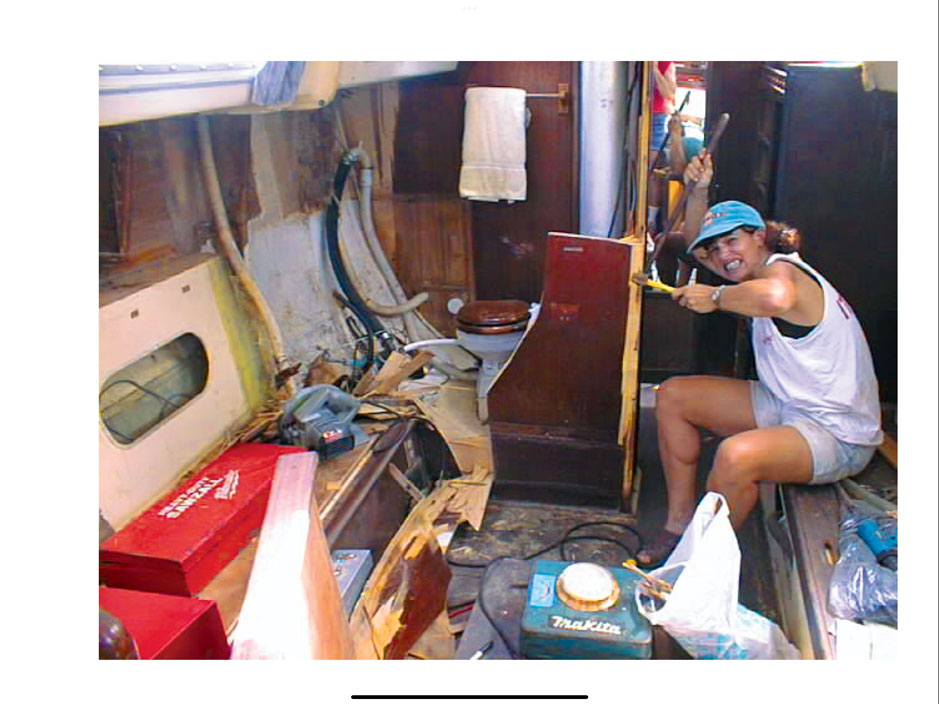
Victory—well, temporarily.
Now we had no galley sink but could haul the boat at our leisure and fix the drain properly. Only one (reoccurring, alas) problem—we had just enough money left over from our social security checks to split a plate of chicken-rice at the nearby food court if we didn’t get a fruit drink… and none left over to be yachty-snotty with.
Damn! Financial reality was screwing us again!
Now, of course, I knew before purchasing the boat that she wasn’t perfect—million-dollar boats that you can buy for 56K never are. I knew her builders had cheaped-out by not using bronze thru-hulls with generous flanges and large bronze nuts. They’d opted instead to glass in (far weaker) plumbing nipples. I also knew that my bilge was full of stainless, plastic, bronze, brass, iron, and pot-metal fittings… much of which had been added by various owners desirous of turning the boat in the giant battery with Mother Ocean acting as the electrolyte.
This is the reality of buying a 40-year-old boat—even a quality one like the Wauquiez.
Twelve of her fourteen seacocks hadn’t worked when I purchased her—and I only managed to replace a few before shoving off. (Each seacock that doesn’t work has the appropriate-sized wooden plug tied to it with kite string that can be easily snapped. Thus, no hunting around for the plug in an emergency.)
So, sure, I knew that I was circumnavigating on a less-than-perfect craft. But if I’d have refitted all that (and far, far, far more) stuff that needed refitting, I wouldn’t have been able to sail around the third time—nor complete half of my fourth circ.
I’m the guy that goes. I’m the guy that shoves off, leaves his comfort zone behind; the guy who has spent his whole life Chasing the Horizon. That’s who I am. That’s tattooed into my DNA.
…compromise, right? I’m not gonna let evil billionaires circumnavigate while I sit in port with my thumb up my butt—no way!
I’m a man!
I get things done! I kiss life full on the lips!
…thus, I sail the world on a less-than-perfect but entirely-serviceable vessel—as I have since 1952 aboard the Alden schooner Elizabeth.
Let’s be honest—by today’s standards, Ulysses’ boat was a mess as well. Ditto, the Spray.
But back to Ganesh and the Compromise of the Poor.
Now, the inboard end of the nipple serving as a thru-hull had a ring of something welded/corroded to it—something too hard to remove with a giant pipe wrench. Whatever it was, it was really, really on there. So, I shrugged and left it.
…not an ideal solution but an affordable, practical one.
I then went to a giant plumbing supply store run by Bangladeshis that couldn’t speak English. And as they screamed, “No have, no have!” at the top of their lungs, I pole-vaulted over the counter and dashed for their bins of spare PVC-fittings.
Seventeen dollars later I returned to 44-year-old Ganesh—and cobbled the new fittings together with hose. How? Stupidly? Cleverly? Your choice—your guess is probably as good as mine. I knew this: I had a pair of galley sinks that needed to drain and a hole in my hull seven feet away—and it doesn’t take a genius to figure out how to get from here to there. (When I’m in doubt as a marine plumber, my professional motto is more hose clamps!)
Were you, dear reader, good at Legos? If so, you can sail around the world. That’s right—it really doesn’t take much intelligence to add nipples and elbows together. Some balls, sure—but any idiot can join plumbing parts. It’s easy-peasy!
Do I recommend this? Of course not! I recommend that you buy a new million-dollar yacht and if there’s a slight problem—haul it immediately and flood the bilge with expensive ‘marine experts’ which may (or may not) know their port from their starboard.
…but I’m describing what I do—and have been doing for the last 66 years of living aboard and ocean sailing. I simply don’t take no for an answer. I refuse to be intimidated by reality. And I certainly don’t sit around in port blaming others for my inability to seize-the-day.
I’m in charge of accomplishing my watery dreams—and I don’t care how many billionaires spending tens of millions of dollars on their gin-palaces tell me I can’t. Screw that. I want to be the freest man in the universe—and, so far, none of the ‘bean-counters’ manning the cash registers have been able to stop me.
Vivo Yo!
Yes, I’m happy for billionaires to have clipper-bowed monstrosities built for them at gigantic cost. (But, honestly, not so happy about the supply vessel wallowing in its wake, furiously burning up the fossil fuels that future generations will need… while its dirt-dwelling owner greenwashes the whole thing with, “…the wind is free!”)
I mean, yeah, having a sculptor put your latest wife’s tits on the figurehead under the bowsprits is certainly, er… a novel idea—good luck with that!
But you don’t need a billion bucks to sail around the world. What you need is a basic boat, some seamanship, and a sense of humor. (Seamanship is just common sense learned offshore. No, seamanship can’t be bought—it must be earned, which is why so few have it.)
The funniest part is that these billionaires stupidly think they are on the safer, better prepared craft.
Ha!
In our experience, it is almost always the shabby, hard-used boat that rescues the gold-plater.
What’s the only thing that could have saved the Bayesian from disaster? If its not-too-bright owner had had a few billion dollars less.
How have my ‘dumpster’ vessels managed to average between 6,000 and 8,000 nautical sea miles between 2000 and 2020?
Well, not by throwing money around. Money is often the problem, not the solution.
Let’s take it how-to, step-by-step.
One, I carry a large amount of carefully scrounged ‘boat junk’ as I cruise the harbors (and marine dumpsters) of the world.
Life is risk, pal—and you have a choice. Allow wealthy folks who have never been offshore do the cost-to-risk calculations for you—or do them yourself.
I do my own risk assessment—and, at 200,000 miles sailed over the course of 66 years of ocean sailing with empty pockets, I’m pretty-much-okay. Actually, I’m more than okay. The last time I worked for The Man was in the late 1970s. Screw The Man! The Man wants wage-slaves. I’m not a slave. I don’t bend a knee. I don’t cower. I’m a sailor—and sailors don’t admire nor fawn on shore-bound oppressors, regardless of political affiliation.
Two, I lug a lot of tools around the world—plumbing tools, metal working tools, carpentry tools—you name it, I got it.
There’s an entire tool room cabin on Ganesh! Not many 43-foot vessel owners can say that.
Three, I’ve never paid anyone to work on any of my boats because I need to know how everything works. Yes, I can tear apart carburetors, watermakers, or a diesel engine in my sleep… because I’ve done it many times before.
…because I had the advantage of having no economic choice.
…being dead-broke in exotic ports is my Super Power, dude!
In 1968 at 15, I purchased a boat without an engine—well, just a severely-rusted engine block without a head, starter motor, nor (6-volt) generator. The rusted tight engine didn’t even turn—well, not until I poured oil in the rusty, open cylinders and put a monkey wrench on its crankshaft with a six-foot breaker bar… then it kinda turned, begrudgingly.
What to do? I found an identical Atomic Four Utility for sale for $50, talked the guy down to $45, and lugged it back to my dock. There, I took both identical engines to bits—and the result was one engine that ran (mostly) for many years afterwards.
Did it run perfectly? Naw, but it was the perfect way to learn about marine engines—and why not start with a flathead engine where the crank/valve/cam mechanisms are easy to understand?
Messy? Yeah, it’s kind of a messy way to learn, sure. But I retained the lessons, so that at 73 years of age, not many things scare me that can be fixed with a combo of wrench, sledgehammer, and some swears.
Life can’t be purchased, it’s to be lived! Life is education.
Here’s why I’m a good… er, a decent mechanic: because I know that fixing stuff is just intelligence-applied.
Here’s the bottom line: go to the coast. Point offshore. Within 12 or 15 miles offshore of the coast, there’s nobody there. It is the same ocean, in basically the same condition, as Joshua Slocum experienced—and you don’t need anything that Josh didn’t have to enjoy it.
…if your ship’s clock doesn’t work then boil the damn thing!
Now, to a landlubber—suddenly having an underwater fixture gushing hundreds of gallons of water into your vessel per minute might be terrifying. To a seasoned sailor? Naw. Not really. Big deal!
Does anyone know where I left my dive mask?
…hold my beer.
Life happens. A good man (or, increasingly, a good woman) deals with it. He or she doesn’t grab their credit card, grab their marine directory; they don’t panic and check if their iPhone is fully charged.
Anyway, our sink drain stopped working. We fixed it without hauling out… for under twenty bucks. Then we immediately returned to what’s really, truly important in life—making goo-goo eyes at each other in the cockpit.
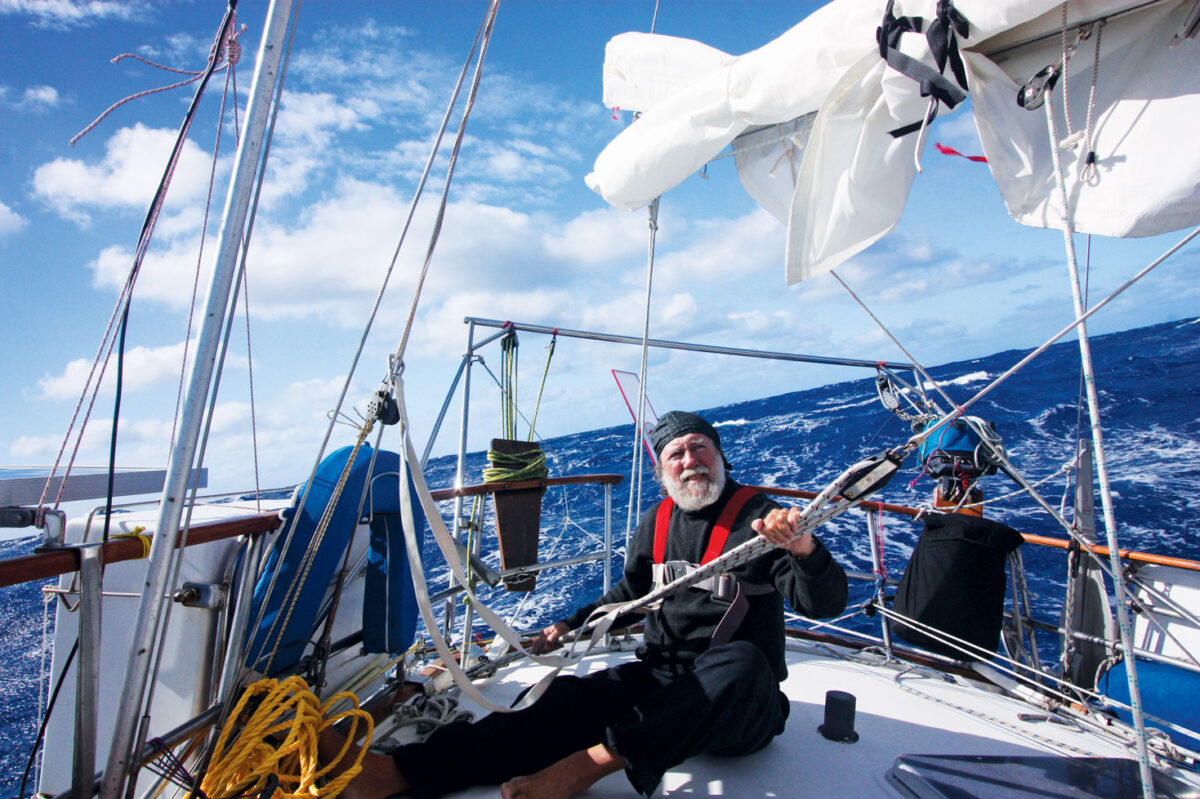
Fatty, in his 66th year of living aboard, is having as much fun during his second childhood aboard the ketch Ganesh as he did in his first childhood aboard the schooner Elizabeth.
Cap'n Fatty Goodlander has written for ALL AT SEA since 2005.
Goes straight to Fatty. ALL AT SEA takes nothing.
Worth your time?
Thanks — noted.