















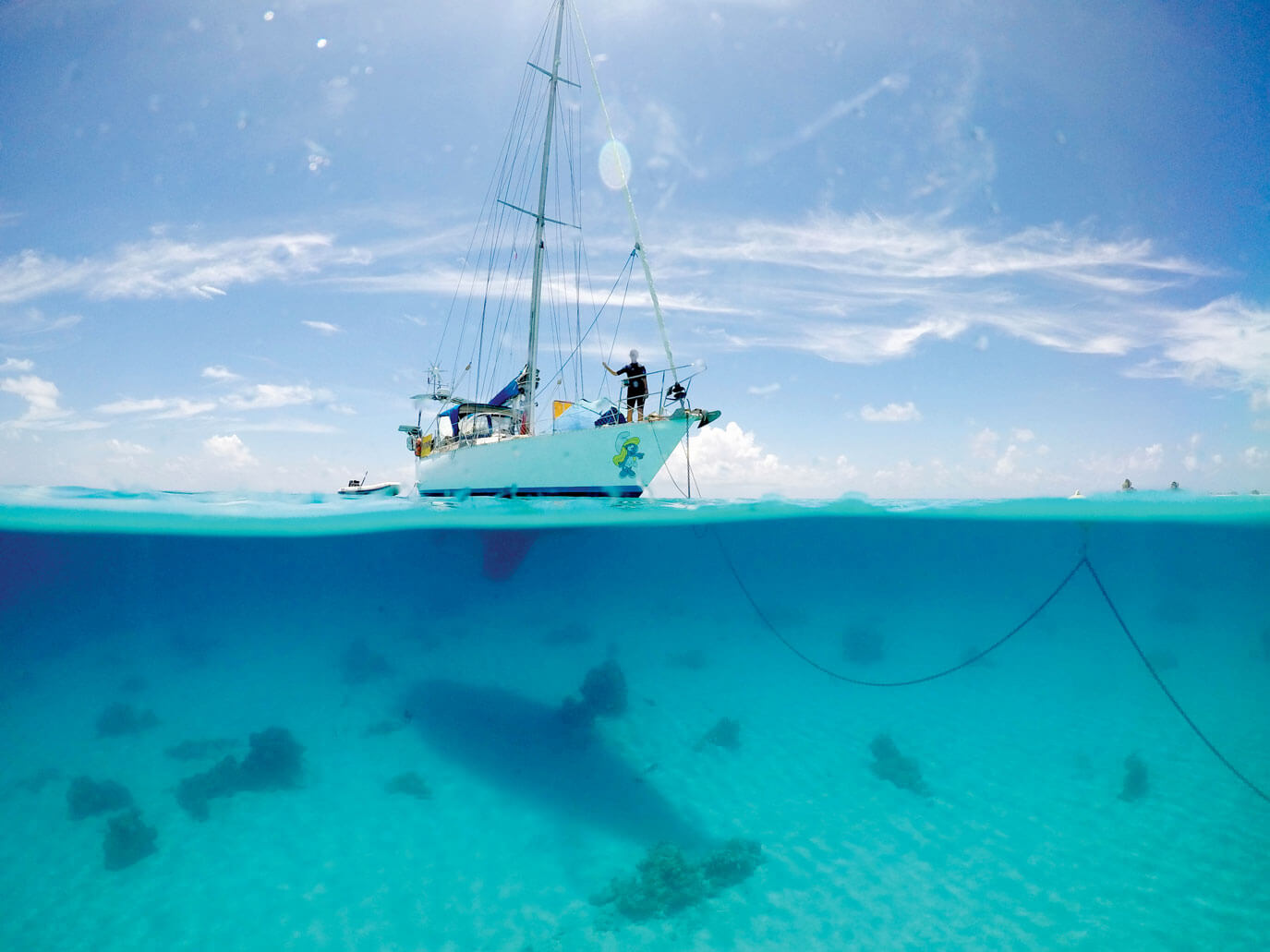
Anchoring in Coral: Tips for Safe & Eco-Friendly Anchoring

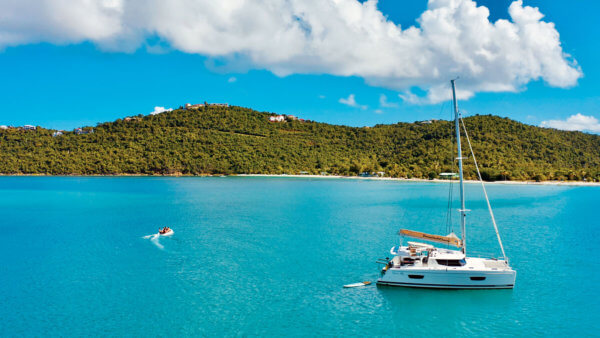
How to float a chain. Isn’t it wonderful to get out of the marina and anchor off a little island? Just drop the sails, drop the hook and drop into the water for a swim. But wait, often it’s not quite that simple: Many of the prettiest islands are surrounded by coral heads and reefs, which guarantees wonderful snorkeling, but also makes it quite hard to find a spot to anchor in. It takes the right timing, special techniques and some extra material to anchor safely and environmentally-friendly in such areas.
Plan ahead and don’t rely on waypoints. We usually download high-resolution satellite pictures of the area in advance, to get an idea where anchoring might be feasible and then try to time our arrival with the sun high in the sky for good visibility. We take our time exploring the area and search for a big, sandy patch to drop the hook. It doesn’t work to just rely on a waypoint taken from a cruising guide or fellow sailors. You won’t hit the middle of a sandy spot relying solely on waypoints as boats have their GPS antennas at different positions (hardly ever at the bow), waypoints are approached from different directions, and the GPS fix may be off by a few meters–all those errors combined may easily put you 60 feet away from the actual spot.

Dare to explore shallow waters. The only way to anchor correctly and safely is to go to the bow and actually look. The sea bottom is clearly visible only in shallow water (less than 10m) where it is possible to precisely place an anchor and chain on a sandy patch. In deeper water the refraction of light makes this impossible. Slowly maneuvering in shallow water is rather exciting in the beginning, but you quickly learn to distinguish the different shades of turquoise over sand and green to brown over coral and to read them as depths. If in doubt it’s good to send someone in the dinghy with a portable depth sounder to scout! Don’t forget to take a look at the tide table before deciding on a shallow anchoring spot.

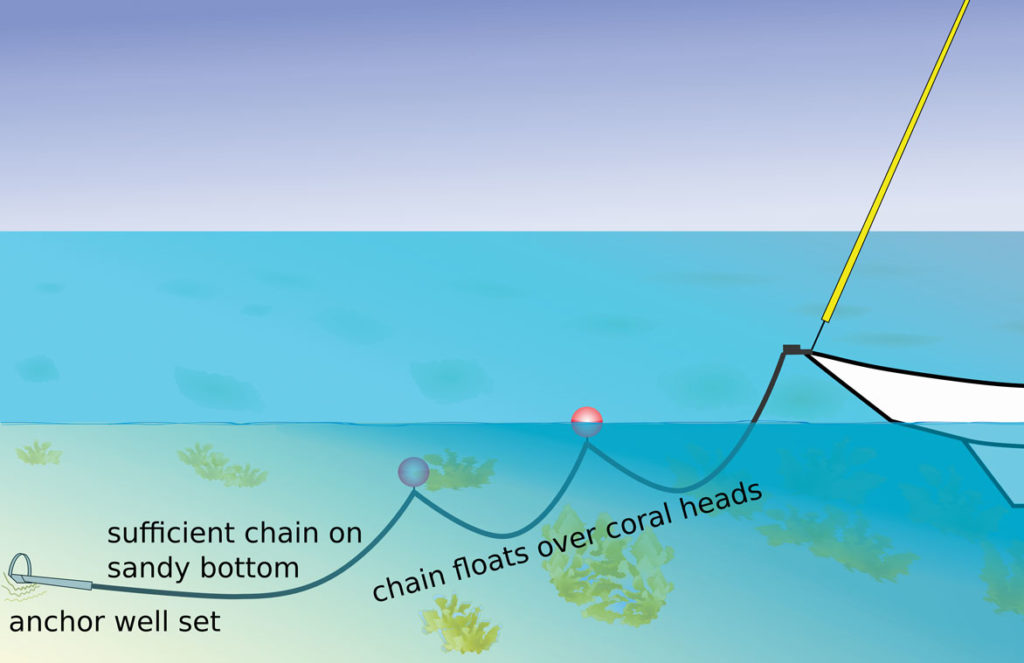
Floated chains keep coral and boat safe. If the sandy patch is not big enough to swing around with sufficient scope, environmentally-conscious cruisers float the chain using fenders or buoys. Sadly we often have to watch neighbors fouling their chain in coral, either due to a lack of awareness, experience or adequate anchoring gear. Questioned about their motives, the reply is usually an indifferent shrug, or paltry excuses. Recently old salts shocked us by stating their usual method of anchoring was to drag the anchor until it got stuck in coral, as their Delta anchor would not set in sand… The result of such behavior are desolate rubble fields underneath popular anchorages and anchoring bans which then keep out eco-friendly cruisers as well. A fouled chain is not only an environmental issue but can also endanger the safety of the boat when the chain is fouled in coral after a shift in the wind direction. Having just a short piece of free chain left while pitching madly is a dangerous situation and the results are stressful maneuvers to get the anchor back up, bent bow rollers and ruined or even ripped out windlasses.
Floating the chain is a simple procedure. You just need:
• 3 or 4 floats (buoys work best, fenders get compressed when submerged)
• carabiners that fit into your chain (e.g., 8mm for 10mm chain)
• short pieces of line to attach the carabiners to the buoys
1. Drop the anchor in the middle of the biggest sandy spot you can find
2. Pay out chain while reversing gently
3. Estimate your swinging radius and check the surrounding coral heads. Hook in the first float before the chain could touch any of them.
4. Pay out some more chain and set the anchor gently pulling in reverse.
5. If the scope is still not sufficient, a second float can be added followed by more chain.
It is important to have a good anchor that sets quickly, e.g. our Bügelanker (similar to a Rocna) sets in sand within less than 1 meter. If your anchor needs to be plowed until it is dug in (e.g. CQR), you will have a hard time. For good holding, the sandy patch must be large enough to have sufficient chain on the sandy bottom before it is lifted by the first float. There is no fixed recipe after how many meters the first buoy should be attached as this depends on the depth and the density of coral heads in the area. If necessary we add another float and even a third one. As long as it’s calm the chain hangs in loops between the floats and remains over coral heads, when the wind picks up, the chain stretches out as it usually would and the floats get submerged. Of course it’s true that floats partly nullify the weight advantage of a chain, but they also add elasticity to the system to dampen the impact of gusts in heavy weather.
Anchoring blindly in the deep blue and routinely attaching ‘alibi floats’ to the chain reduces the risk of getting tangled up somewhat, but this strategy should only be used in locations without a proper sandy shelf between the island or reef and the deep lagoon. If anchoring deep, use a bundle of two floats to carry the weight of the chain. Searching for the right spot and fiddling with additional equipment may take a little more time, but keeping the coral and your own boat from harm is certainly worth that extra effort.
Birgit and Christian have been anchoring around half the globe for 13 years. Visit their blog www.pitufa.at for more info and check out their books “Sailing Towards the Horizon” and “Cruising Know-How” on Amazon.
Birgit Hackl has written for ALL AT SEA since 2012.
Worth your time?
Thanks — noted.