On Sailor’s Souls, Obsession, and Love
Why do sailors call their boats "she," talk to them in storms, and grieve them like family? Cap'n Fatty Goodlander traces the habit through five decades and five vessels — from the schooner he grew up singing on, to the ghost who still haunts his current ketch.

I am interested in sailors’ souls—and how they perceive themselves. I’m also interested in how others have viewed seafarers throughout history, from Ulysses to Bernard Moitessier. I’m especially interested in how sailors view their vessels, which is, I believe, part of the psychological underpinnings of their survival at sea.
Huh?
Too nerdy—too narrow—of a subject for a marine column? Not really. Not in my case because I’m a bundle of neuroses nurtured upon Mother Ocean. Why wouldn’t I be interested in how my many major flaws (and a few tiny strengths)
have congealed?
Let’s start with the linguistics—it’s Mother Ocean, isn’t it? And, ignoring literary trends and PC-ism, a boat is (or was) a she. (If captains of yore were female, they’d be he, I’m sure.”
Obviously, we anthropomorphize our vessels. We endow them with life. We give them lofty attributes that we, as small and myopic as we are, lack.
I talk to my vessels, in ways both trivial and weightily. In 1967, about ten minutes after catching sight of the engine-less, rig-less, dilapidated double-ender Benevolence (which I renamed Corina), I stood in her cockpit and announced aloud to no one but her, “…don’t worry, honey, I’ll rescue you—we’ll Chase the Horizon together.”
I was sixteen. It took many years and tears, but I did exactly that—not merely for myself but because her nobility demanded and deserved no less.
Yes, I would own her but she would own me too. And, if our love affair was successful, we’d do right by each other.
…freaking weird, right?
My father would often tell me as a young aspiring offshore sailor, “Listen to the boat, son—she’s smarter than you’ll ever be.”
I’ve based all of my circumnavigations on this simple principle—in times of stress, I listen to the boat. I ask her, humbly, what she wants and needs. I accommodate her and she (and her ancient wisdom) keeps me safe.
Before Corina, as a child, I’d sing songs every night with my family on the deck of the schooner Elizabeth, the boat I grew up aboard. As our lovely harmonies drifted across the anchorage, I could hear her, the boat, joining in.
She was our seashell. She protected our family. We’d found her sunk and about to die—and we’d breathed life back into her with air flotation bags and many years of sweat. We bonded. We were each other’s destiny.
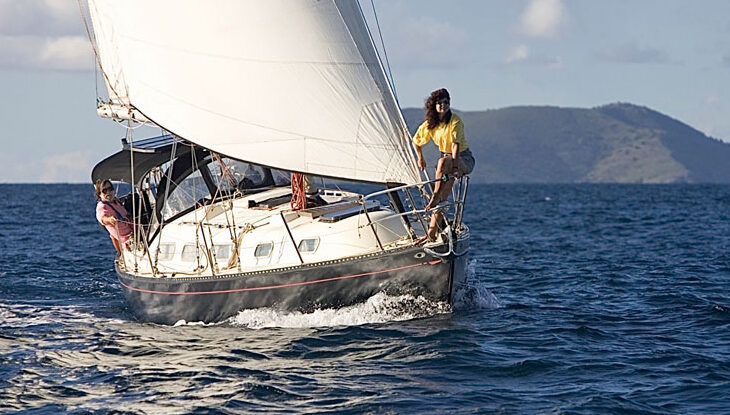
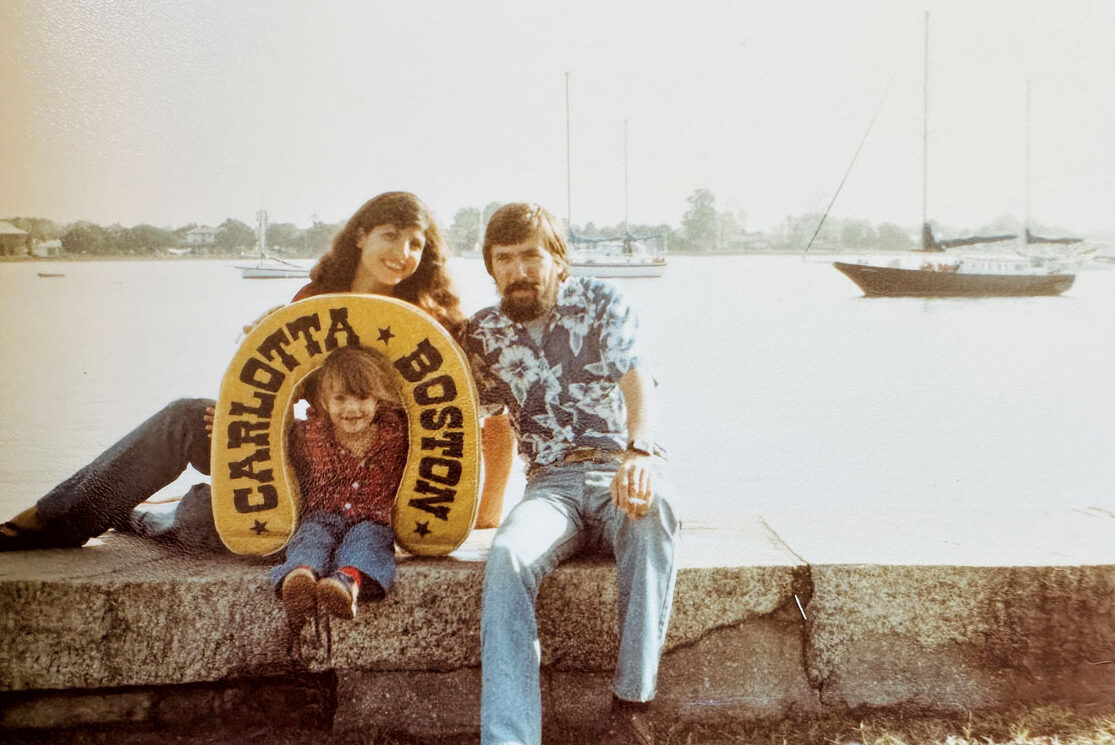
In 1971, at the age of 19, we (my wife Carolyn and I) built the 36-foot ketch Carlotta from scratch, from a few sheets of paper and a tiny table of offsets. Piece by piece, hope by hope, I carved my expectations into her over the course of six long, extremely difficult years.
We’d sail the world together.
But life isn’t a fairytale and on September 17th, 1989, a dragging 70-foot schooner aptly named Flyaway became jammed sideways on our bowsprit —at the height of Hurricane Hugo, a category four.
I wept, deeply ashamed, as I swam away from her holed hulled with my seven-year-old daughter in my arms.
There was another vessel nearby merely holed and awash, so I smeared her with dried snot (aka fiberglass) and sailed her twice around the world.










But before I did that, I anchored Wild Card off the wreck of Carlotta, and rowed over to apologize to the vessel I’d berthed with my hands.
Our conversation was too brutal, and too horribly sad, to repeat in print.
Wild Card was a cheap production boat which was, in my wife Carolyn’s words, “…weaker than your morals, Fatty!”
Wild Card had more leaks than the White House.
The only things keeping her together were the roaches holding hands.
But she was game, and I urged her on across the wide Pacific, the windy Indian, and the fickle Atlantic—not once but many times.
Now, at the age of 74, I dotter on the deck of Ganesh, a posh 45-year-old, 43-foot Wauquiez ketch, during a multiyear pause in the middle of our fourth circ. Last weekend, we sailed from Changi Beach, across Serangoon harbor, to nearby Ubin Island. I explained to our grandchildren (and their friends) how we’d come to be blessed by Ganesh and her ghost.
Ghost?
“Once upon a time,” I told the kids, “Ganesh was called Pappy Bus, which translates to Grandfather’s Bus in French. She was built in France and owned by a wonderful Frenchman named Rogér. His dream was to circumnavigate South America and he fixed her up and provisioned the boat to do just that. But, before shoving off—with the boat crammed with spare parts and brand-new equipment, he went to the doctor for a check-up. It was determined that he needed more medical tests; and before those tests were complete, he died.
But poor Rogér couldn’t rest—not with the boat-of-his-dream sitting in Marigot, St. Martin, all set to go.
So, he restlessly haunted Pappy Bus, which was hauled out at the time.
Now Roger loved kids and wasn’t too overly fond of Americans. So, he began sabotaging his wife’s yacht broker. The broker would bring childless, too-wealthy Americans to see the boat—and Rogér would arrange for a loose floorboard to trip them into the bilge or whatever. Soon the broker gave up trying to sell her—too many ensuing trips to the hospital!
A tree branch started growing between mast and forestay.
The boat didn’t ‘show well’ to put it mildly.
But when I came to view Pappy Bus, I brought my daughter and our babbling grandkids, and we spoke to the boat reverently in (poor but understandable) French. Voila!
Now, instead of Rogér the Ghost making me hit my head on an open overhead locker, he left drawers ajar so that I could see the value of all the spare parts and new autopilot and the brand new asymmetrical in the forepeak. He wanted Grandfather’s Bus to continue to be just that—so, instead of cursing us, he blessed us.
And, for the first year or two in the Pacific, Rogér acted as crew-superior, especially when our grandkids were aboard. Eventually, just before clearing in New Zealand—knowing that his boat was now in good, safe, loving hands—he slipped away.
The kids love that story—and, of course, so do I. But my point is that for those first few years, I not only spoke to the boat as if she was human—but to the ghost of her former owner as well.
Odd. Crazy, even. But kinda nice too. And we actually kinda missed Rogér when he was gone but have, in our own small way, tried to do right by him in terms of his vessel’s legacy.
Why are we sailors driven to anthropomorphize our vessels—especially during the Great Age of Sail?
Perhaps to survive—that’s my personal theory.
Sailors are often viewed as cold and distant—nothing couldn’t be further from the truth. A more romantic, mystical group doesn’t exist. Throughout maritime history, sailors have loved their vessels—even while hating their corporate owners. Wise captains have exploited this love. After all, when the emotionless, cold-hearted ‘boat-worker’ spots a stranded shroud or torn sail, he might say nothing and leave it for the next watch to discover. But the true sailor, steeped in seamanship and love, can’t be so cruel. Regardless how much he hates the owner and barely tolerates the skipper… it is the vessel that is his true mistress, the object of his love and his lust that he must do right by.
So, the captains nurtured this ‘love of the sea’ because it made his ship safer and better maintained. The owner concurred because they made his vessels more profitable. And, of course, salt-stained ink-slingers such as myself have sung the praises of such behavior in Chasing the Horizon and every other piece of writing I’ve sold in the four-decades-plus.
Crazy? Stupid? But with an element of truth sewn within?
You decide, dear reader.
But I love my family and the vessels that nurture them almost in equal measure. That’s why, when I sold Corina, I paused when a lubber offered me X-number of dollars—to find a payphone and tell the real sailor at the other end that this was his last chance to buy her for half of X-number!
I eventually send my boats out into the world like children—flawed, sure, but loving each one wholeheartedly.
And I’m not alone in this love or delusion—Bernard, Slocum, Voss, Melville, Dana, and Harry Pidgeon did too.
I talk to my boats because I believe it is to my (and my crew’s) benefit.
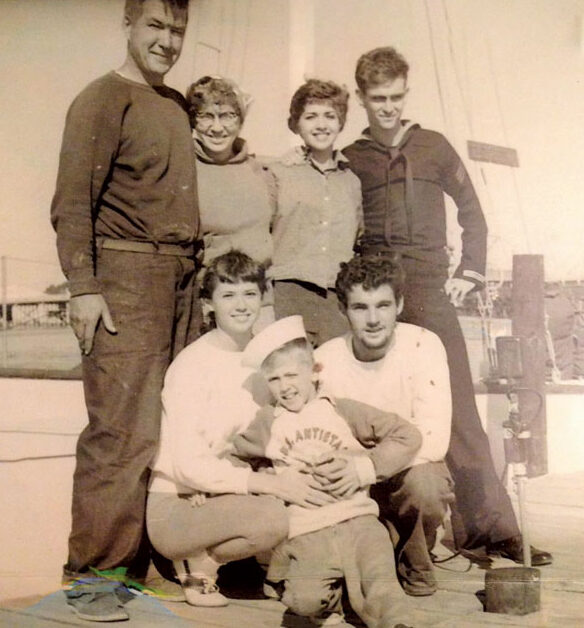
Elizabeth showed me a better way to live—made my life uniquely sea-centric rather than land-centric. Corina proved that I could take empty pockets, no rig, and no engine—and sail it many thousands of ocean miles while convincing my wife to make the only two mistakes she’s ever made in her entire life… saying “I” and “do” were both of them.
Building Carlotta from scratch while none of the other boat-building commune members launched during the ensuing decade—gave me utter confidence that, with Carolyn’s help and support, I could do almost anything.
Changing gears and patching up Wild Card showed that I could roll with the punches, that if I couldn’t sail away one way, I’d sail away another—damn the torpedoes, full steam ahead!”
And that, from my book royalties, I could purchase the posh Ganesh, a finer yacht than I could ever imagine owning!
Other vessels have touched my heart as well. Olin’s Stephen’s Stormy Weather charmed me on the way to Bermuda. Thatcher Lord’s Bounty beguiled me during many Wooden Boat Races. Ditto, Bill Rich’s Golondrina, a wooden Concordia yawl.
I dream about these boats—not pretend dream or daydream—I actually dream about them, in ways both uplifting and nightmarish. For instance, I dreamt that, during Carlotta’s launching, she didn’t float… that the straps never relaxed and that she just ignobly disappeared from sight, leaving only bubbles and a shocked, silent crowd dispersing without looking me in the eye.
Jesssssssus! (She floated perfectly on her lines, which does not prevent the dreaded nightmare from reoccurring.)
Another recurring dream involves the late Pieter Stoken of IBY, Independent Boat Yard.
Pieter is a man for whom I have tremendous love and respect—as a sailor, a businessman, a husband, father, and dear friend—but dreams are weird, right?
Anyway, in the dream, Pieter calls me to Brenner’s Bay. There’s a crowd of drunken, stoned, mentally-unstable (is there any other type?) Lagoonies waiting there. They seem excited. Everyone is smiling with great expectation—fiercely attempting to not ruin my surprise-of-a-lifetime. Pieter walks us all over to a large boat shed and rolls back the tall, heavy door. There’s a vessel inside, but I can’t make it out. I step from the warm, confident sunshine into the scary, chilly darkness—and cry out in shock. I don’t mean to gasp aloud, but I can’t help myself. I cry out in utter, absolute horror! It’s the Elizabeth, all-rotten and hogged and seaweedy and sagging around the cradle.
My life as a husband, father, and writer is over—I must-must-must rebuild her to protect the family honor.
I’m f***ed, totally f***ed!
Here’s the thing, dear reader—we own our boats, sure, but they own us too. We’re almost as much slaves to them, as they are to us. To judge me as a sailor and a man, all you had to do was glance at Carlotta. I’d melded with her—just like a hang-jowled old man and his morose bulldog.
Did I do right by Corina? Should I have not sold Wild Card to that goofy male stripper who callously allowed her to sink in Grenada?
I’m not kidding you—these boats bless and torment me! Nothing reveals my personal shortcomings more than my vessels. Sure, you can insult my wife—but if you criticize the sheer of one of my vessels—well, I’ll want to immediately ‘take the discussion outside’ into the parking lot.
The truth is that I really can’t let these boats go—they won’t allow me to. They pursue me with their historical & hysterical joys and sorrows. And they never give up!
Yesterday, while anchored between Malaysia and Singapore—while in the cockpit tucking in a splice to our new three-strand anchor rode, I got an email on my iPhone. It was from a guy who we’ll call Davy Jones. It read…
Fatty-
Just happened upon one of your articles in Yachting Magazine where you talked about the burning, sinking, and salvage of the Elizabeth.
I am **** **** great grandson, live in Illinois, and am a lifelong Great Lakes sailor.
The Elizabeth is a wonderful part of our family’s sailing history. I have always heard that it burned, and that was as far as the story went.
I was shocked and completely fascinated to hear that the boat was salvaged and continued to sail for many years afterwards.
I have a lot more on the topic and also a great photo of the Elizabeth you might enjoy, and of course many questions.
Before going further, let me send this and make sure this is an active email address for you.
See what I mean! The Elizabeth haunts David too, and he never even trod her decks! He never even saw her!
…he says that she is an important part of his family’s history… not was, but is.
…and the Elizabeth sank out from under his family in 1936, ninety-freak’n years ago!
Crazy? Damn right—but kinda nice, too! (end)
Cap'n Fatty Goodlander has written for ALL AT SEA since 2005.
Worth your time?
Thanks — noted.