The Evolution of a Watery Friendship

St. John, USVI, is—or at least was—awash with hippies in the late 1970s. It was, indeed, a sunny place for shady people. For me, this was part of its attraction. Its tie-dyed charm—the dilated-eyed, utopian innocence—appealed. We were all high on brotherhood and good vibes, and we didn’t care who knew it.
We were young. We were unabashed. And we were unstoppable.
Example: after a heavy rain, some shop-owners in Cruz Bay would close their businesses and leave a sign in their window that read, “Shroom Holiday—see you on Sage Mountain.”
Sage Mountain was on nearby Tortola—just a hop, skip, and a trip away from reality.
Yes, my wife Carolyn and I began to headquarter out of St. John in the late 1970s precisely because it wasn’t normal or practical or profitable or well-organized. The joke at the time was that many of its long-haired residents had been airlifted out of Woodstock—but had been too zonked to realize it. “We’re all here because we’re not all there,” seemed more than apt; it seemed definitive. So did “Rehab is for quitters” and “Just a little too much is just enough for us.”
As a group, we solemnly pledged to never work for The Man. And we promised ourselves to never become The Man either—to never succumb to lure of being an exploiter, a user, a power-freak.
Were we naïve? Perhaps. But we also had the confidence of youth. Time and tide was on our side. And brotherhood wasn’t merely an ideal, it was something to be practiced daily.
Yes, One Love!
















On St. John, everyone received the reputation they deserved. It wasn’t based upon a numerical quantity such as $$$ but rather something more complex and far more interesting.
Compassion? Equality? Justice? Kindness? Personal grace, maybe?
Let’s put it another way. After MLK was assassinated, I vowed to leave Amerika. St. John was as far away (on all levels) as I could get and still retain the legal protections of our American Constitution.
Water seeks its own level. I wasn’t alone. Misfits from the ‘upper 49’ states drifted haphazardly down the social and financial ladder to Key West Wasted. Many of those twisted folks who were too weird to drink at the Green Parrot, ended up at either at the Backyard in Love City or Redbeards in Coral Bay.
Sadly, some of us grew up and abandoned our starry-eyed, utopian beliefs—but not all.

This is a tale of one sailor who, on some level, didn’t. He was an empty-pocketed guy named Tom, who showed up in the 80s aboard on a modest, beat-up 32-foot cruising vessel from St. Louis via Key Largo.
And while Tom Gerker didn’t bring any money with him, he did bring one precious asset: his relationships. He was friends with a sailing drifter named Lonny and a kid who’d escaped the coal mines of Appalachia (in a kayak) named Joe.
These two men trusted Tom—no small thing in this world of constant corporate bamboozlement. He’d made promises to these men and Tom had kept them—not because it was necessarily profitable but because those promises had been made. His word was his bond.
Again, no small thing. Trust is the glue that holds the world of commerce together.
Let’s view it another way. Tom helped those two men and they helped him: not by printed agreement but through gratitude well earned. Tom’s idea was very, very simple—to be nice to others and hope a few of those ‘others’ would return the favor… and to never forget who was who and which was which.

It was utopian, yes; but it was practical as well.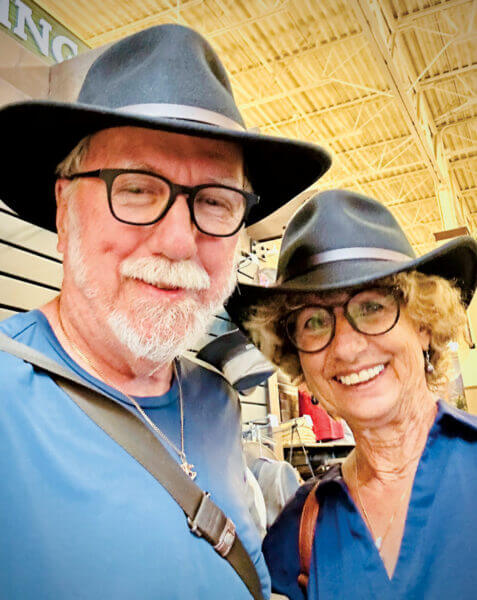
And, in many ways, it is what organizations like the Rotary Club are based on—goodwill and merit. Rotary Clubs might be a bit ‘square’, but they get stuff done.
They’re the guys and gals who don’t complain about litter—they recognize litter as a problem and do something about it. Themselves. Directly. Independently. And immediately.
The Rotary is, at its core, a can-do organization.
And Tom was, and still is, a free thinker. He is ever willing to listen to reason, to reassess, to allow sobering facts to speak plainly for themselves. The free marketplace isn’t something to be dictated to but rather to be learned from.
He believes in PEE: plan, execute, evaluate. And repeat. And repeat.
He’s tenacious and takes the long view.
And then, what you actually do with all that wealth—well, that’s another matter.
There’s one more element we need to mention—Tom’s midwestern roots. He can spot bullshit a mile away—a trait shared by all good business managers. And, despite Tom’s liberal leaning, he is straight as an arrow. He never consumed anything stronger than red wine with a side dish of optimism.
Anyway, in the early ‘80s, we sailed into Coral Bay and anchored next to his modest vessel. I rowed over (no expensive outboards in those days) and clung to his toe rail as I listened to his life story, which ended in his running an ever-growing marine business in Key Largo—and his managing to escape the velvet handcuffs of success.
Huh?
What kind of ambitious wacko goes to a remote place like Coral Bay to set up a business with the specific intent to keep it small, personable, and barely profitable?
I mean, WTH?
Equally as interesting as Tom was his wife Barb—a hardworking, eternally-busy woman with a wide smile who both adored Tom and had a kind, encouraging word for everyone in Coral Bay who happened to swim by.
I’m impressed by Barb—nothing flashy, just the wife that every man prays for.
Tom soon developed a niche—a hippyish, idealistic business plan—which was both true to his ideals as a concerned citizen and yet might actually turn a profit. The charter industry of the USVI was growing by leaps and bounds. Why not start a marine service business in Coral Bay for Caribbean charters in the offseason? A place where they could have their yachts artfully and affordably refitted in the most laid back, most distant, most out-of-touch harbor under the American flag?
The result was Coral Bay Marine. It rapidly became the largest employer in the area with its handful of live-aboard employees. And wonderful waterfront wackos. And colorful Caribbean characters.
I immediately realized that Tom was a Dreamer. Dreamers were common in those days. But Tom was a dreamer who turned his dreams into reality—for the benefit of as many folks as possible.
That’s rare.
To put it another way, every time I asked if Tom’s business was profitable, he’d grin and say, “We’ve never missed a payroll, Fatty!”
Perhaps that’s the key to Tom’s business sense—his pride is never missing a payroll, not bragging about his personal wealth.
In essence, he was a strange mix of the idealistic and the practical.
Despite the USVI having a large budget for Youth Sports, its personnel never seemed to be able to get as far east as Coral Bay. Thus, Tom and his company began to reweld the well-used basketball backboard each time it broke. And CBM not only became the biggest employer on the east end of St. John, it also became a major sponsor of the Coral Bay Regatta because—well, you had to pay back in Tom’s view. And, if somebody—local or visitor—needed to be rushed to the St. John Clinic, Tom always had a vehicle that usually ran well enough to make the journey down Centerline Road and had fuel in its tank.
Tom viewed a business as something that gave him power and effectiveness—and how he used that power was his worth as a human being.
Of course, Coral Bayers were suspicious. Tom was never seen wandering around the harbor naked or drunk or herbally-confused. Odd, the guy was damn-right odd! He never quite fully fit into the community because he was too busy networking with the local government, the owners of the yachts that his company serviced, and the strange brew of marine misfits workers that he corralled into twisting his wrenches.
Tom was a dynamite mechanic who didn’t like to get his hands dirty—the benign captain of his company, not its deck swabbie. Tom had vision. He was ambitious. He felt that the bigger his business became; not only the more money it could make, but the more good it could do as well—for its employees, himself, and the community at large.
He not only joined such civic organizations as the Rotary Club—his boundless energy allowed him to rapidly rise to the top.
While he personally worked from sunrise until late in the evening, he always had the time and talent to take on yet another worthy task.
People around him soon realized that if you wanted to get something done, you asked Tom. No matter how busy he was—no matter how many red flags stuck out of his dog-eared Week-at-a-Glance planner—he’d make the call or organize the meeting or bend the ear of the power-people concerned.
Then tragedy struck. The year was 1986. A group of local Boy Scouts drowned in Pillsbury Sound. Why? Because they (and their scout leaders) barely knew how to swim, knew nothing of local currents, couldn’t row, and lacked even a rudimentary knowledge of seamanship.
Tom teamed up with Ted Cummings—a West Indian dentist who’d been born in Barbados—and the youth organization KATS (Kids and the Sea) was born. It wasn’t easy to get the program off the ground. Many locals fear the sea and have instilled that fear in their children. Tom organized folks to 1.) go to potential student’s homes to reassure their parents, 2.) provide free transportation to and from the classes, and 3.) give ‘scholarships’ to students who couldn’t afford the extremely modest fee.
Schools were visited—as well as public housing.
Oh, and if the kids couldn’t swim, they’d be funneled into (and guided through) a learn-to-swim program so they could then join KATS. At first, only rowing, knot-tying, and basic seamanship was offered—but soon sailing, yacht racing, match-racing, and team racing were options as well.
A doctor donated his Rhodes 19. Somebody gave a beat-up J/24. Other cruising boats were donated as well—even a lovely yawl that used to be a USCG training vessel.
Donations were accepted, of course. But to raise additional funds to buy more Optimist and Laser one-design dinghies, ANTS was formed (Adults and the Sea) to funnel more donors into the sailing program.
It worked.
The result was that, initially, Coral Bay’s KATS program was the largest and most dynamic program in the USVI and the BVIs—despite Coral Bay being in the (relative) boonies.
Even better, many of the KATS kids participated in the annual Governor’s Cup, run by the VIMI, the VI Marine Industry association. (Yes, the Governor showed up each year to pass out the Silver.)
Since I was a journalist (for Caribbean Boating) who covered both VIMI and its Governor’s Cup, Tom Gerker and I soon fell into traveling together to St. Thomas for monthly VIMI meetings as well.
He also talked me into becoming a founding member of the ANTS (Adult and the Sea) program.
Despite all the time that Tom spent on community work and with the KATS program, he also grew his business as well. First, he became a dealer for many top brands—then the Caribbean wide distributor of such brands as Perkins, Northern Lights, and Lugger engines.
He was a man-on-the-move—and those in the industry began to take note.
But it bothered him that the USVI government wouldn’t fix the basketball hoops of its own children—nor to support the early KATS program either.
“If the USVI government doesn’t care about its kids in a practical, effective manner—what does it care about?” Tom once mused to me.
The USVI contrasted sharply with the BVIs in this regard. The BVI government and parents strongly supported the KATS program. Volunteers were plentiful. Funding was available and the result over time was a much more vibrant marine industry on Tortola—one in which the locals felt they were the beneficiaries of—not the victim thereof.
Tom and Barb moved to Tortola. Parts and Power started expanding like crazy—distributing JCB construction equipment as well as many power-grid products that municipalities throughout the Lesser Antilles need as their populations, collective wealth, and electrical grid grew.
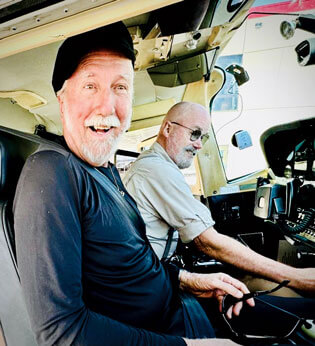
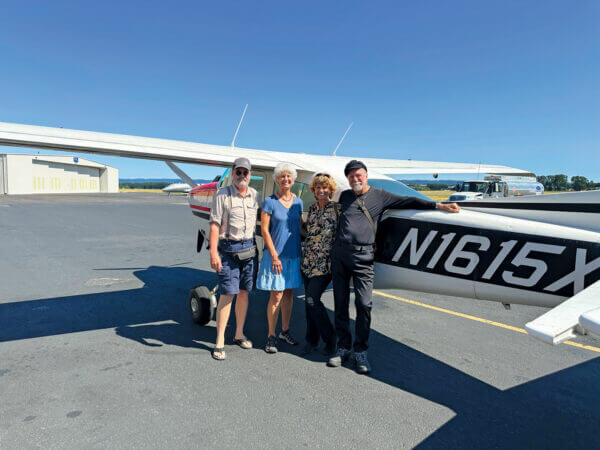
Now, as much as Tom loved to sail his ketch-rigged Whitby 42—he liked to fly as well. Soon he purchased a hard-used airplane, fixed it up with chewing gum and bailing wire, and started flying it around the Lesser Antilles
Of course, he needed a co-pilot (victim, really) that had both a low-IQ and thought that bumpy landings were preferred. I fit the bill perfectly.
Tom bristled that he was ‘just flying’ and thus, when a sailor down island would need, say, an o-ring or #10/24 ss nut—we’d fly it down to him.
This also allowed Parts and Power to expand into more distant realms. We flew to Trinidad and Puerto Rico many times. (I acted as a down-island guide—and was known in the corporate corridors of Parts and Power as the infamous Zen Arrow. (As a guide I never knew where I was, but I knew exactly where we were going—which sort of confused the more step-by-step style of Tom.)
Tom and Barb built a lovely house atop a mountain (large hill, I guess) on Tortola. Tom loved to grill steaks, so each time we sailed into Road Town, I’d remind him of the fact that I loved to consume steak as well.
My extreme gluttony started to evolve into a lifelong friendship.
But as Tom’s business gained new employees and my own career morphed into circumnavigating, we began to see less of each other. Sure, he sponsored my Radio One Marine Report on WVWI during our first circ and we kept in touch via email (when the Internet evolved) but we didn’t spend much time together.
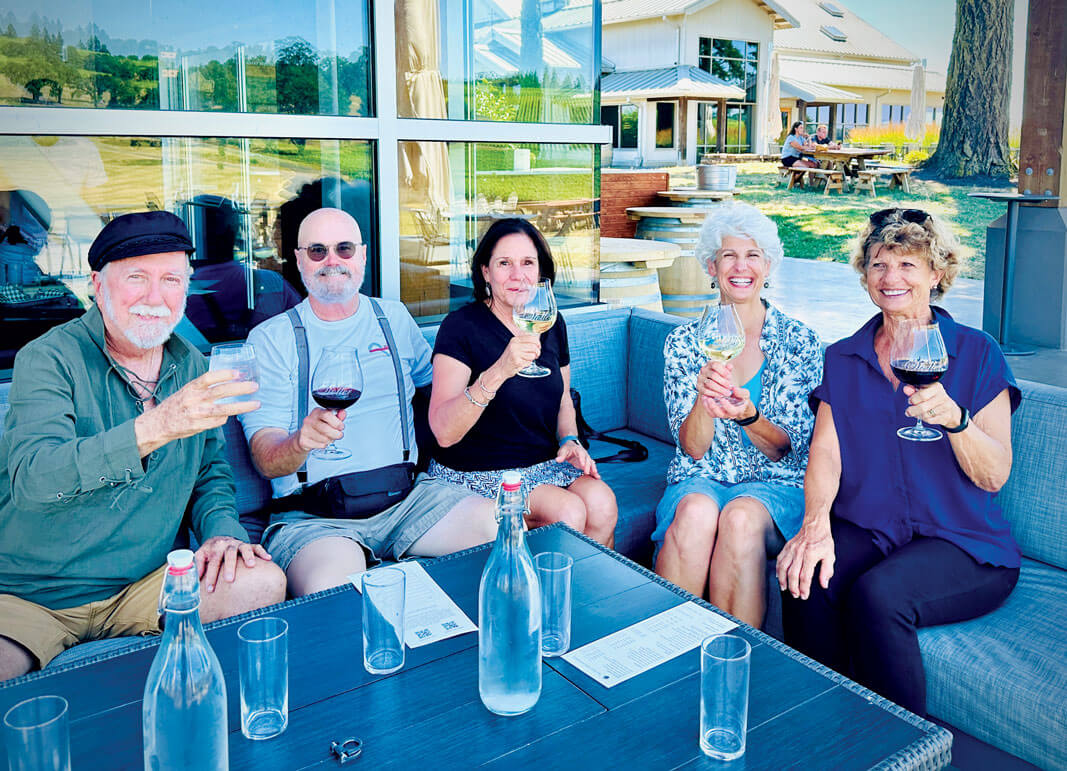
Thus, I was a bit surprised last year—nearly 40 years after our first meeting—when Tom asked if we’d like to meet him and Barb to party-hearty in the Portland area. Huh?
He’d fly his plane from the BVIs and I’d take commercial airlines from Southeast Asia
Sure, why not?
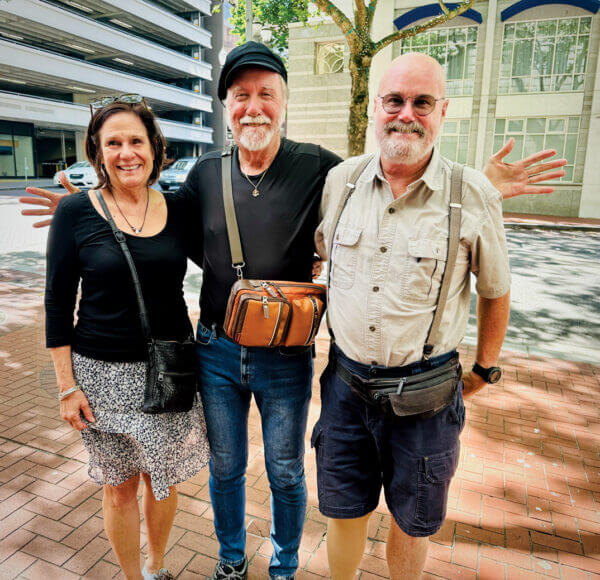
Thus, we recently spent a week together in the Portland area—and in the clear blue sky above it—laughing our butts off at the stupid things we did during our wayward youth.
I was astounded. It was as if we’d never been apart. Our four-decade-long friendship was immediately rekindled—in the sky, at Starbucks, and across the dining room tables of various gullible people on the ground.
Were there hard times on the way up for Tom and Barb? You betcha! Hurricanes, warehouse floods, and lawsuits ate huge chunks of their capital reserves. Many of their best employees, whom they’d spent years training, moved on to more profitable jobs in the States or started their own companies down island.
The eventual bottom line is that Tom and Barb—through a lifetime of hard work and perseverance—have grown Parts and Power into a powerhouse of electrical power generation and marine propulsion in the northeast Caribbean.
Just recently, they had their best year ever. And, throughout, they’ve never missed a payroll!
Even better, the childless Tom and Barb—at the zenith of Parts and Power financial success—signed over a huge chunk of ownership to its local employees.
Remember when I said Tom was a Utopian? Well, he’s proved it with the ripe fruits of his lifelong labor—seasoned by the blood of his own corporate battles.
Yes, he and Barb still work at Parts and Power. But they increasingly take longer and longer vacations to allow its staff to gradually shoulder the responsibilities of ownership.
And, of course, to take time off to wrestle me for restaurant checks in Portland. (Why do I always lose… damn it?”)
Yes, in life, character is destiny. And, yes, in a fair world the cream always rises to the top.
Editor’s note: Fatty and Carolyn are now back aboard in Singapore—pretending not to notice how much weight they gained in American eateries.
Cap'n Fatty Goodlander has written for ALL AT SEA since 2005.
Goes straight to Fatty. ALL AT SEA takes nothing.
Worth your time?
Thanks — noted.

Fatty: You are truly blessed. He knows you. Keep up the good.