Keeping Your Dinghy & Outboard Safe: Essential Tips for Cruisers
Avoid costly mistakes with your tender! Learn proven techniques from seasoned sailors on how to prevent your dinghy from flipping—and what to do if your outboard ends up underwater.

A sudden gust on this otherwise calm afternoon spins around our SY Pitufa, which is anchored close to shore, with a shore line to a dock. The line creaks in its cleat on the aft deck and both Christian and I look up from our laptops down in the salon/home office with sudden alarm. “The dinghy!”, I shout, but he’s already running up the companionway. I follow as quickly as I can, but we come too late: the dinghy got lifted as the formerly slack stern line had become taut underneath it. As we are watching it falls back into the water, but upside down… We can see the metal floorboards tumble towards the bottom, croks and oars are floating away, but we have no time to go after them. Saving the outboard is more important now. Christian pulls up the flipped dinghy from Pitufa’s high stern and I manage to turn it around. Then we hoist the Tohatsu aboard and spend the rest of the afternoon cleaning the outboard.
HOW TO AVOID FLIPPING A TENDER
• With a shore line or an anchor line fixed to a cleat on the aft deck, tying the dinghy to the stern is a no-go (as we had to find out the hard way). It is much safer to tie up the tender on the side of the boat, far away from lines that go unexpectedly taut.
• With heavy weather predicted it is safest to store the tender as if you were preparing for a rough passage. Yes, conditions might not get that bad, but you never know, better safe than sorry. Lifted up on davits the dinghy needs to be tied down additionally (not just left to dangle) or if you don’t have davits (like we) the best place for the dinghy is up on deck, secured with several lines.

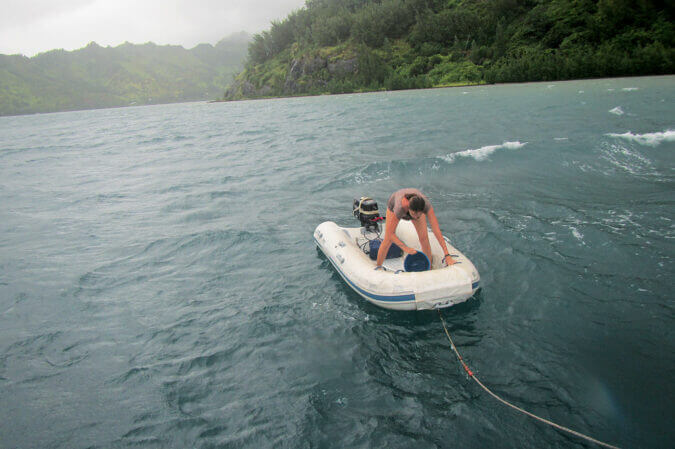
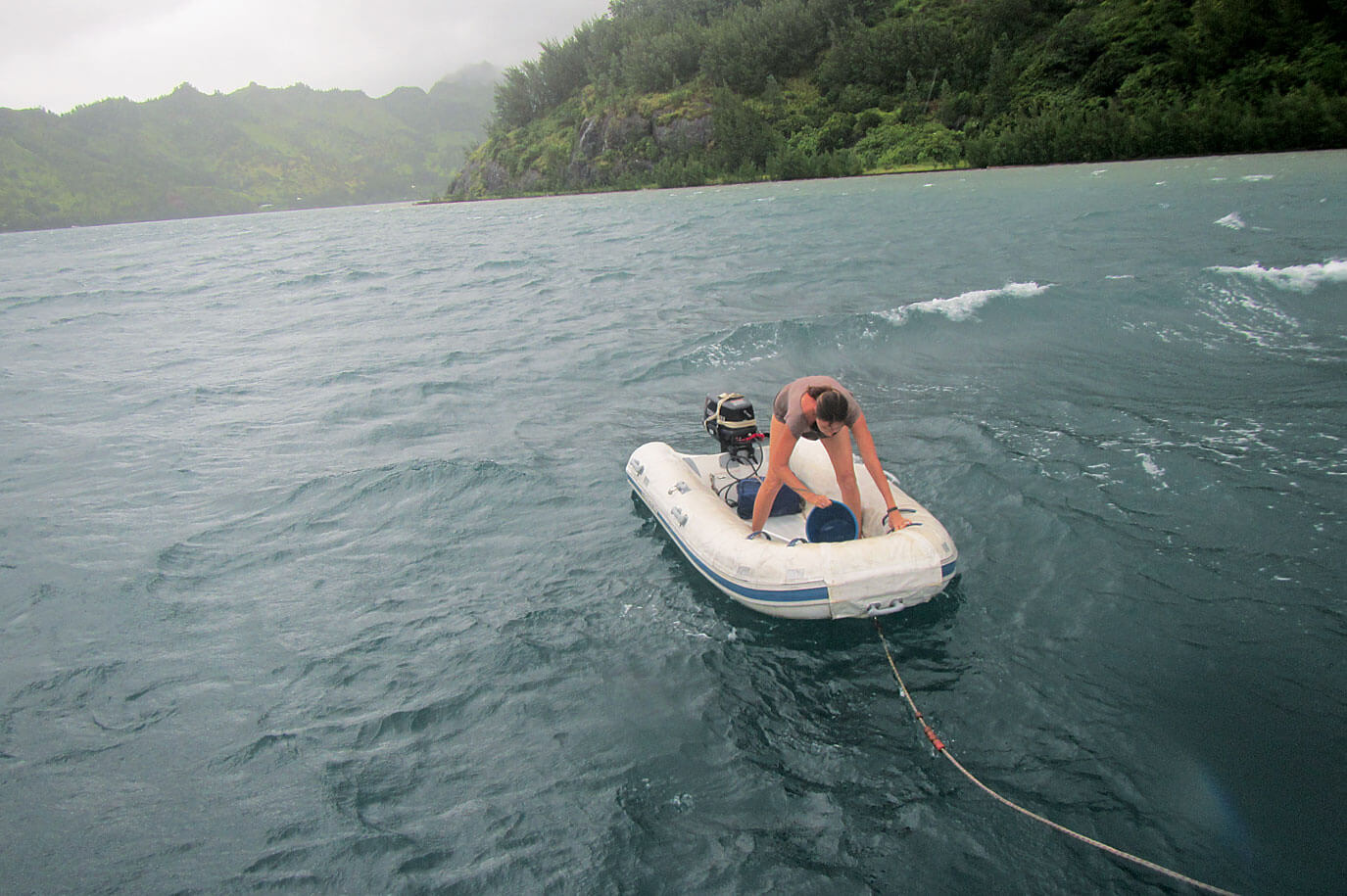
• Sometimes unexpected strong winds and gusts arrive without any previous warnings from forecasts and suddenly you find yourself with a dinghy tied with a painter to the stern and conditions that are deteriorating with the boat pitching and rolling too violently to safely lift the tender. In such a case a somewhat counter-intuitive measure is to fill the dinghy with water, as the additional weight will keep the wind from flipping it over–of course only after taking the fuel tank, shoes, oars and whatever else lives in the dinghy aboard.
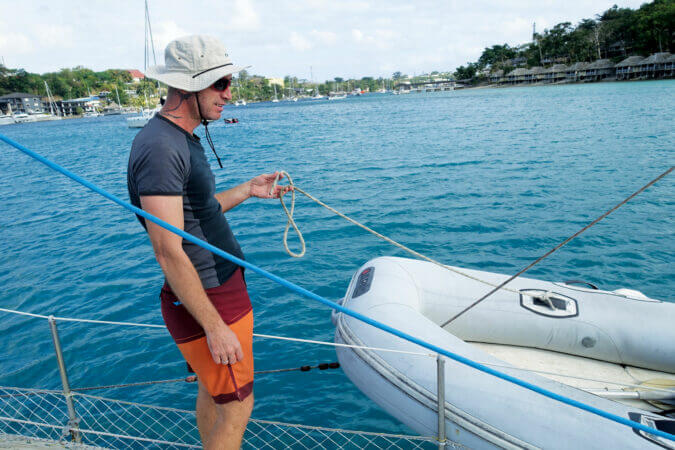
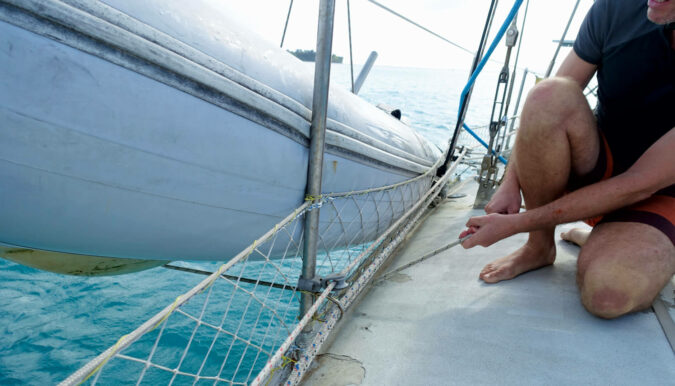
• If the dinghy is already up on the davits, tying additional safety lines is relatively easy, even if it’s already pouring down and blowing. If you keep the dinghy lifted on the side with a halyard (like in our case) it is not so easy to keep the gusts from the side from canting it sideways against the hull. We usually tie the dinghy painter to a cleat on Pitufa’s bow and a stern line from the dinghy to a cleat amidships when it’s lifted for the night. In gusty conditions we tie an additional line to the far side of the dinghy (see picture) and lead that line underneath the keel of the dinghy and tie it to Pitufa’s toe rail. This additional line keeps the tender stable, even if a strong gusts hit the side of the boat.
WHAT TO DO WHEN THE OUTBOARD GOT SUBMERGED:
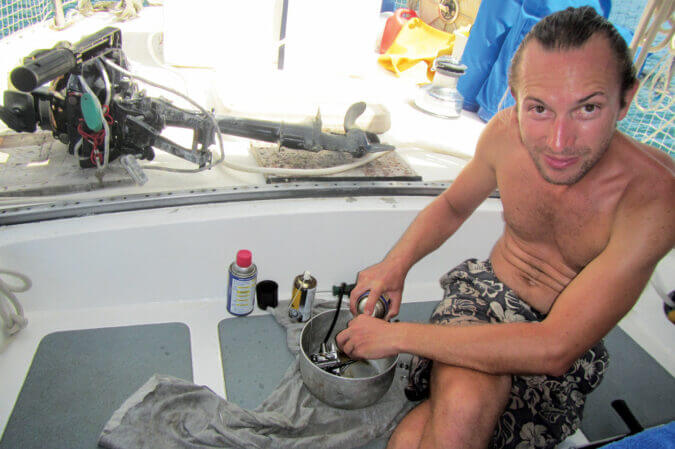
An outboard that was dumped into sea water (even if it wasn’t just for a few seconds like with our stern-line accident, but for a longer time) may unexpectedly start after a few energetic pulls on the starter cord. It may even keep running for a while afterwards, but at some point the salt that entered during the ducking will start working on its innards and eventually corrosion will bring the poor thing down. To avoid this it is vital to give it a good rinse with freshwater as a first-aid measure and then to disassemble the mistreated outboard and give all sensitive parts a bath in diesel. Remove the spark plugs and rinse them. If the engine has been submerged for a while it is best to rinse them first with freshwater and then with diesel. If it was only a matter of moments, just pull the starter cord repeatedly, so the pistons move and the diesel gets in contact with all parts. The carburetor can be removed and cleaned separately, the intake should be flushed with diesel as well.
By the way, be careful, outboards can take a plunge into seawater, even if the dinghy stays upright! Cruiser friends forgot to tighten the screws on the stern plate of their dinghy and as soon as they started planing the outboard just jumped off the stern and disappeared into the deep blue. We once left our dinghy unattended at the dock and either playing kids or someone with a nasty non-sense of humor thought it was funny to undo just those screws. We noticed just in time, but checking those screws after leaving the dinghy at a dubious place or even connecting them with a lock, can keep the outboard out of harm’s way!
















Birgit and Christian have been buzzing around with 3 generations of dinghies for 13 years. Check out their blog www.pitufa.at for more tips and tricks or read their books “Cruising Know-How” and “Sailing towards the Horizon” (available on Amazon).
Birgit Hackl has written for ALL AT SEA since 2012.
Worth your time?
Thanks — noted.