















Beyond the Beam: Secrets to Unlocking Upwind Cruising in the Caribbean

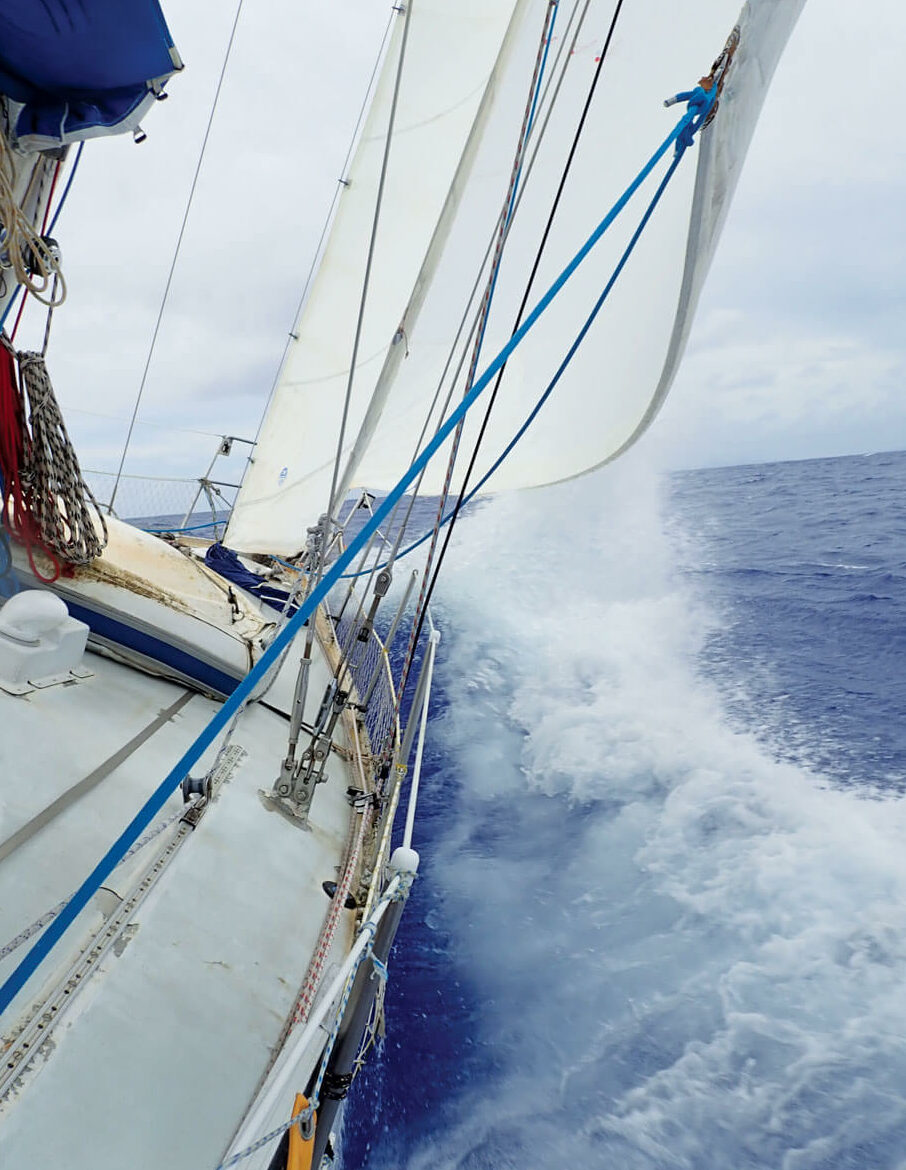
“A gentleman never sails to windward!” All sailors know this old saying and many cruisers who would never consider themselves gentlemen under regular circumstances, suddenly turn very posh and upper-class when it comes to finding excuses for not having to bash into wind and waves. But then, those gentlemen miss out on many interesting destinations upwind from where they are.
The Caribbean enjoys some of the most stable weather in the world. While other areas in the tropics have a “sailing season” with trade winds in winter and unstable convergence-zone weather with fickle winds and calm periods in summer, the trades blow reliably almost all year round from the east between the many islands of the Caribbean. This makes choosing anchorages easy—if there’s protection from the east you’re good. It’s certainly a blessing for those traveling westwards (even though rolling on a dead-downwind course isn’t everybody’s cup of tea) and it basically guarantees pleasant passages up and down the Antilles with the wind on the beam.
So far so good. But what if you find that you have missed a great destination? Or you want to revisit a favorite bay further to the east? Then it’s time to swap the big genoa for a smaller headsail, lash up gear on and below deck and wait for favorable conditions.

Weather windows
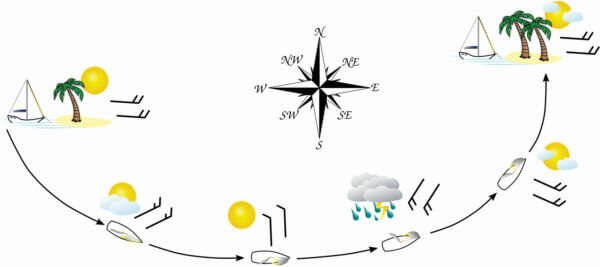
Even though the trade winds are very stable, they still occasionally get interrupted by lows. When a low passes by, the winds clock around and make it possible to sail to the next destination eastwards on a single tack in a curve as the wind direction shifts (see sketch). It may take a long time in the Caribbean to get such an opportunity, but with lots of time and patience (or luck) the opportunity to ride a low is a perfect way to make miles towards the east. Of course you could simply wait for a period of calm weather or light winds and motor eastwards, but enduring a hot, noisy engine for days is neither fun nor helpful with your carbon footprint.
Preparing the boat
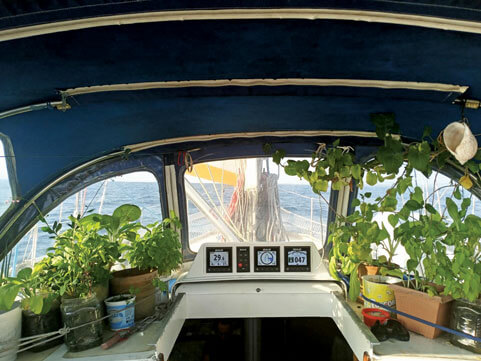
Checking the rig in anticipation of a challenging passage is always a good idea. If you have a selection of foresails stowed away, now is the time to get down the big genoa and pick a smaller, high-cut foresail that is less cumbersome to tack and still keeps a nice shape when rolled up reefed in strong winds. Cutter-rigged sloops have the advantage that the little, inner foresail provides additional canvas when sailing close-hauled in light winds while being a safe option to still make headway in very strong winds in combination with a double-reefed mainsail and the foresail rolled up completely.
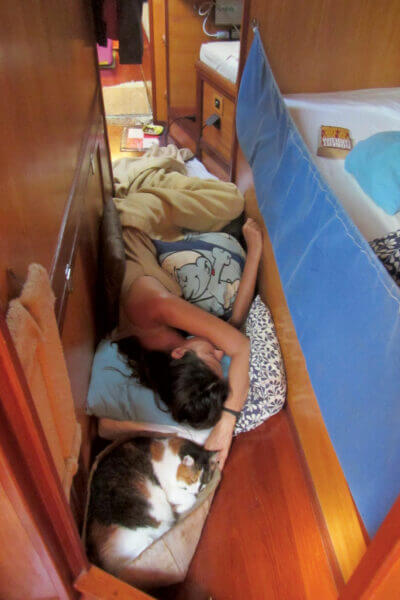
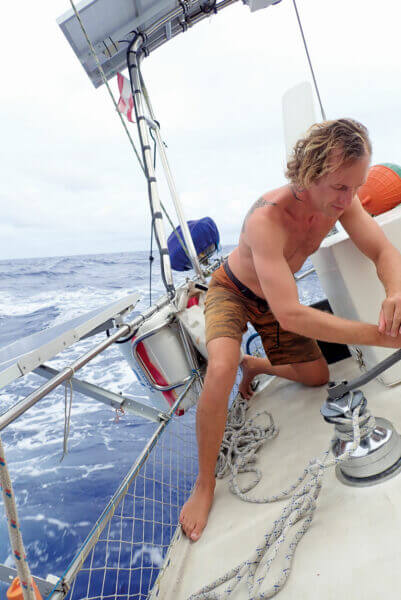
We hate it when our Pitufa gets into a pronounced roll on downwind passages—she’s also really good at corkscrewing, which is even more nauseating than rolling. The good news is that you won’t have that motion while sailing close-hauled. The bad news is that crashing into waves while heeling will empty the shelves in the salon as well, but at least you’ll be able to predict in which way they’ll fall. If a passage can be done on one tack, you know exactly which side of the salon has objects waiting to get airborne, if you know you’ll be tacking up and down ,you’ll have to secure everything with ballistic potential both on the starboard side as well as the port side. Don’t forget to close thru-hulls that might turn into geysers once the boat starts heeling.
Stronger wind for better tacking angles
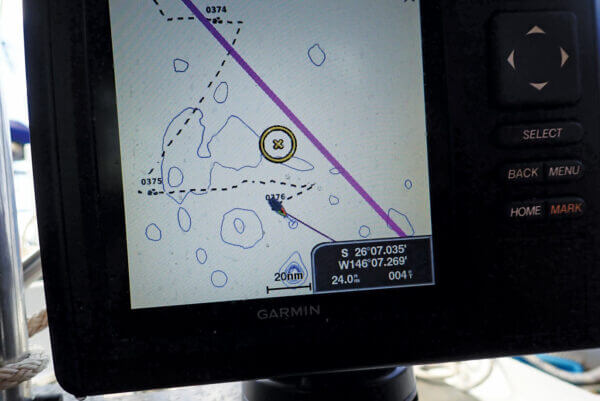
If the winds stubbornly insist on blowing from the east, it is tempting to look for periods with a lighter breeze to avoid high seas. Unfortunately the difference between apparent and true wind angle increases in light winds. Most boats also have more drift with lower boat speed, so it’s even harder to keep course. Of course the tacking angle is worse in such conditions—it may happen that you end up sailing back on the GPS track you’ve only just drawn on the chartplotter. A very disheartening view (been there, done it).
Using windshifts for favorable tacking
Unless you have a racing boat with high-performance sails, the only way to achieve an impressive-looking GPS track with great tacking angles is to work with subtle shifts in the wind. Just keeping an eye on the wind instrument might not be enough to notice tendencies in the wind direction, it is much easier to spot such opportunities with a log that shows averages. Watching the 1 minute, 10 minute and 1 hour average of wind direction and wind speed on our nav-data gateway (www.pitufino.com) we can pick the best moment to tack. As the pitufino sends all this data to the mobile phone, we can even wait for the right time while comfortably sitting on the sofa instead of peering at the wind instruments in the cockpit.
Birgit and Christian have been sailing their SY Pitufa up and down the wind for 13 years. More stories, info, tips and tricks can be found on their blog www.pitufa.at or you can check out their books: “Sailing Towards the Horizon” and “Cruising Know-How” are both available on Amazon.
Birgit Hackl has written for ALL AT SEA since 2012.
Worth your time?
Thanks — noted.