How to Anchor a Boat: A Caribbean Cruiser’s Guide

Anchoring well is one of the defining skills of a good skipper—and getting it wrong can mean dragging onto a reef at 3 a.m., a fine from a park ranger, or an embarrassing scene in a crowded anchorage. This guide covers the whole skill for Caribbean waters: where you can legally drop the hook, how to choose the right anchor for the bottom, how to set it so it actually holds, and the advanced moors that handle tight harbors and shifting currents.
Where to Anchor—Legally and Safely
Before you picture the secluded cove and the picnic lunch, picture the National Park ranger writing you a ticket. Anchoring rules vary island to island, and many of the prettiest spots are protected.
- U.S. Virgin Islands — the National Park Service enforces strict anchoring rules; check the NPS site before you go.
- British Virgin Islands — the Wreck of the Rhone Marine Park prohibits anchoring, but mooring buoys are available.
- Tobago Cays — anchoring allowed, but only on sand.
- Bonaire — a national marine park where anchoring is prohibited entirely; use the moorings.
Always check local regulations for a new destination. To find good anchorages, lean on three tools together: nautical charts (NOAA for the USVI and up; Imray-Iolaire for the rest of the Caribbean to Trinidad and Aruba) for depths, bottom, and hazards; cruising guides, which add approach advice, bottom conditions, and even restaurant tips—most experienced sailors carry two or three to cross-check; and local knowledge, which beats everything for current conditions. Chat up sailors at the docks and marine stores, and if you follow a local boat into an anchorage, mind your draft—if they draw three feet and you draw six, their safe line is your grounding.
Choosing the Right Anchor and Ground Tackle
No single anchor is best everywhere—the seabed decides. Match the anchor to the bottom you expect.
| Bottom type | What to do | Best anchors |
|---|---|---|
| Coral | Do not anchor. It is fragile, protected, and can bend an anchor, foul your chain, and slice your rode—plus heavy fines. | — (use a mooring) |
| Rubble (broken coral & rock) | Needs a specialized anchor; poor holding in mixed bottoms. | Barnacle (no good in sand) |
| Grass beds | Use a sharp anchor that cuts through roots—anchors that slide over grass won’t hold. | Danforth, CQR, Bruce |
| Mud | Use an anchor that grips soft mud. | Bruce; mushroom (for permanent moorings) |
| Hard-packed sand | Reliable holding for fluke and plow styles. | Danforth, Fortress, CQR, Bruce |
| Soft sand | Use deep-digging anchors. | Danforth, Fortress (excellent); CQR (some find it plows) |
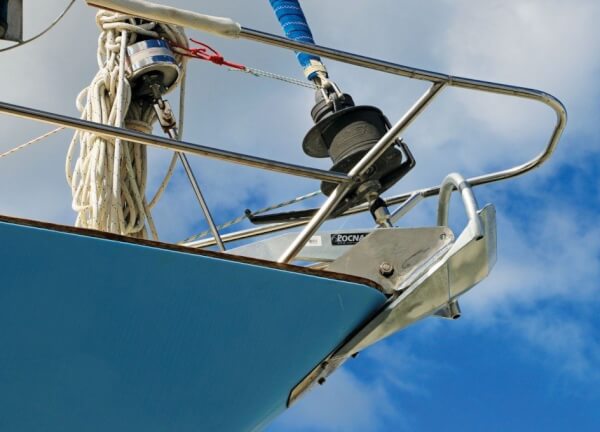
Check your boat manufacturer’s and anchor makers’ sizing charts for weight and windage, and factor in shackle size, chain, and line strength. Many experienced boaters carry several anchors: a heavy primary for cruising and storms, a lighter everyday anchor, a small stern or lunch hook, and—in hurricane country—a permanently set storm anchor. One rule that outranks any chart: choose an anchor you (and your crew) can actually lift and handle. The best anchor is the one you’ll use correctly.
How to Set the Anchor—Do’s and Don’ts
Setting the hook is the easy part—if you do it right. Roaring in and heaving the anchor over the side the moment you spot the beach bar is a guaranteed way to drag.
- Do slow down and read the anchorage. Take a slow lap: note markers and obstructions, wind and current, and how the other boats are lying and swinging.
- Do brief your crew first. Agree who drives, who works the anchor, and what your hand signals mean—before the bow gets noisy. Do not assume your crew can read your mind, and do not scream at them; calm signals beat shouting every time.
- Do prep the tackle. Anchor ready, chain shackled, rode made fast to the boat—so you never drop a hook that isn’t attached.
- Do lower, don’t throw. Pick a sandy spot, lower the anchor gently to avoid tangling, and pay out enough scope.
- Do back down to set. Reverse slowly to dig the anchor in, then add power to test the hold. If it drags, let out more rode or reset—too little rode is the single most common anchoring mistake.
- Do confirm the set. Take a bearing on a fixed landmark (or set a GPS anchor alarm), and if you can, snorkel down to check the anchor is buried and the rode isn’t chafing.
- Do leave room, and ask for help if you need it. Give every boat room to swing a full circle; if someone asks you to move, do it politely. Fellow boaters—who have been watching—will happily lend a hand.
How much scope? The rule of thumb
Scope is the ratio of rode paid out to the total depth (water depth plus the height of your bow above the water). More wind, more scope.
| Conditions | Scope ratio (rode : depth) |
|---|---|
| Calm weather | 5:1 |
| Moderate winds | 7:1 |
| Strong winds | 10:1 |
Example: in 10 feet of water with a 5-foot bow height, total depth is 15 feet; at a 7:1 ratio for moderate wind you need about 105 feet of rode. When in doubt, let out more.
Advanced Anchoring Techniques
Once basic anchoring is second nature, a few advanced moors handle tight spaces, shifting currents, and beach landings.
The Bahamian moor
When wind or current will reverse overnight, a Bahamian moor—two anchors set in opposite directions with the boat centered between them—keeps you from swinging wildly and reduces strain on each anchor. It is the go-to for reversing tides and tight, crowded anchorages. For the full step-by-step, see our dedicated guide to setting a Bahamian moor and other special-condition techniques.
Fore-and-aft anchoring
Popular for parallel-parking close to shore—think White Bay, Jost Van Dyke. Drop the bow anchor in deeper water, reverse toward the beach, and have a crew member wade the stern anchor ashore and dig it in above the surf line, then adjust both rodes to sit stern-to. Only in calm water—an unexpected swell can push you aground.
Med-mooring
Common in crowded harbors like Gustavia, St. Barth and Charlotte Amalie, St. Thomas. Drop the bow anchor a set distance off, reverse toward the dock keeping the rode controlled, secure stern lines to the wharf, and tension the bow anchor to hold position. Be wary of tossing stern lines to strangers who may pull you in too hard.
Rafting up
Tying several boats together for a meal or an overnight is a Caribbean social ritual—but it takes coordination. Plan with every crew beforehand, approach at idle into the wind or current, use plenty of fenders, secure bow and stern lines, and distribute weight so no single anchor is overloaded. Note that you usually cannot raft up on a commercial mooring—check local rules.
Anchoring FAQ
Can I anchor anywhere in the Caribbean?
No. Many marine parks—Bonaire, the BVI’s Wreck of the Rhone, parts of the USVI—prohibit anchoring or restrict it to sand, and coral is off-limits everywhere. Check local regulations and use moorings where required.
What is the best all-around anchor?
It depends on your bottom, but fluke-style anchors (Danforth, Fortress) and plow/claw types (CQR, Bruce) cover most Caribbean sand and grass. Many cruisers carry more than one type to match conditions.
How much anchor rode should I let out?
Use a scope of about 5:1 in calm weather, 7:1 in moderate wind, and 10:1 in strong wind, measured against water depth plus your bow height. When unsure, let out more.
How do I stop my boat swinging into others?
Leave room for every boat to swing a full 360 degrees, and in reversing conditions consider a Bahamian moor to limit your swing.
How do I know the anchor is set?
Back down under power to test the hold, take a bearing on a fixed landmark or set a GPS anchor alarm, and dive on the anchor when you can to confirm it’s buried.
Anchoring — Go Deeper
This guide is the map; the articles below are the terrain. Our contributors—liveaboards, circumnavigators, and Caribbean pros—go deep on each part of the craft.
Choosing your anchor & ground tackle
- The Difference Between Anchor Designs — Capt. Jeff Werner
- Best Anchor for Mud — Terry Boram
- Anchoring Equipment & Basic Maneuvers — Birgit Hackl
Setting the hook & holding
- Will Your Anchor Hold? The Basics — Mark Stevens
Advanced moors
- The Bahamian Moor — Birgit Hackl
- The Forked Moor — Lesley Hayes
Moorings & buoys
- Using Mooring Buoys — Fran & Dee Welk
- Moorings vs. Anchoring — Alex Hewitt-Jones
Where to anchor
- Anchorages in Grenada — Shane McClellan
Living at anchor & the cruiser’s craft
- How to Stop Your Boat Rolling at Anchor — Birgit Hackl
- Creative Anchoring: A Circumnavigator’s Tricks — Cap’n Fatty Goodlander
- Anchoring for Beginners — Ruth Lund
- Zen and the Art of Anchoring — Lesley Hayes
Compiled and updated by All At Sea from J. Summer Westman’s Caribbean anchoring series. Always confirm current local anchoring regulations before you drop the hook.
Worth your time?
Thanks — noted.