


















Understanding What You Can’t See: While casually accessing a new boat, I try to understand what I can’t see.
It’s the things you don’t see when looking at a new boat that are vitally important — usually at 2 a.m., beam-on to a supertanker.

While casually accessing a new boat, I try to understand what I can’t see.
Huh?
Last weekend, I was invited aboard a new, sloop-rigged 32-foot production boat with twin wheels. Twin wheels are currently way-cool. I love twin wheels, especially when racing. I even love moving back and forth between them because, going to windward I like to ‘become one’ with my jib telltales and then, at crowded mark roundings, I like to shift to the ‘high side’ to get a better view of my competitors as we jockey for position.
Plus, twin wheels allow for a person to walk from the scoop transom to the cabin in a straight line—avoiding having to squeeze around a large diameter center helm.
Thus, twin wheels are a win-win-win!
WRONG!
That’s what they look like but not what they are. Two pedestals are twice as heavy at the end of the vessel where weight is critical—any extra adds to the boat hobby-horsing. Twice as much steering cable and more turning blocks are twice as likely to fail in a blow. And the least discussed issue—all those cables running hither and yon belowdecks eliminate valuable stowage space.
Thus, smaller vessels with twin wheels often have no stowage for fenders, mops, buckets, docklines, life jackets, deceased ex-wives, etc.
So, there’s a huge cost to having twin wheels, especially on a small boat. Am I saying you shouldn’t? Not all at. If your dream is two wheels—go for it! All I am saying is that the buyer should be aware of the trade-offs.
Another example: few ketches have spacious aft cabins. My boat, a 43-foot Wauquiez, does. My aft cabin is HUGE—shockingly so. People actually gasp on their way aft as they catch sight of this magnificent, brightly-lit, lovingly-varnished cabin… which is, because of all the teak and mahogany, like living and sleeping and writing inside a finely-crafted violin.
Perfection! I kid you not—I’ve never seen a vessel under 50 feet with such a marvelous—such a stunning—aft cabin!
How is this amazing feeling of space achieved? The hull has excessive freeboard. Ditto, the massive square-area of the transom makes her a tad ‘squirrely’ in following seas. Her cabin sole is unusually low—so low that the (cleverly disguised) bare hull is revealed for four to twelves inches in the cabin (to maintain headroom as the counter rises).
But the real stroke of genius (or idiocy, depending on viewpoint) was just leaving out the chainplate webs for the mizzen mast!
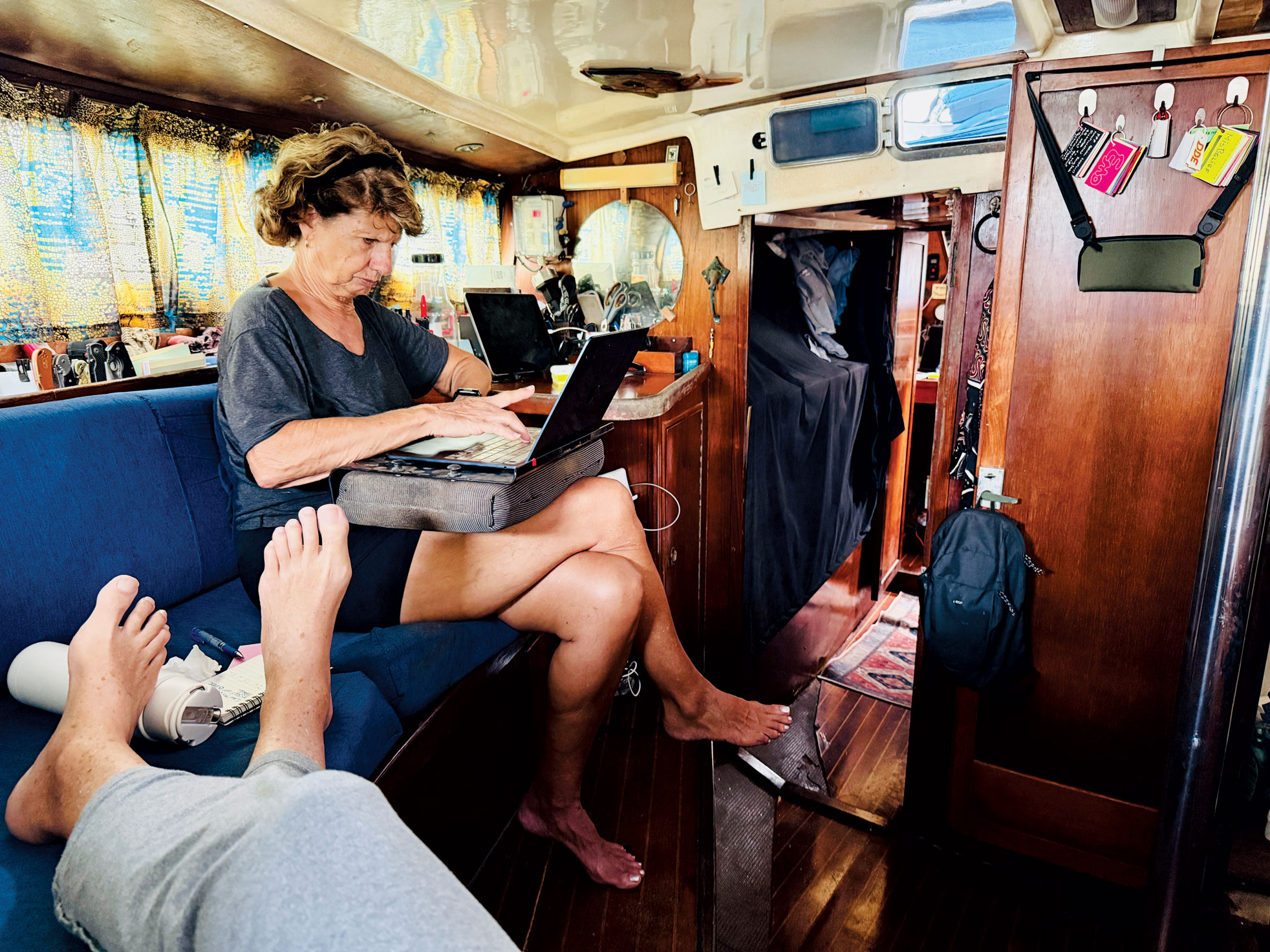
Now, I deeply love my aft cabin—where I’ve written a dozen books. It not only has a super wide double bunk—it has a pull-out table, a wrap-around footrest, and a curved couch that sits four people upright or two lounging with their feet up. It also has six large windows (at this size I can’t bring myself to call them portholes), two large drawers, twelve different 12v lights, a make-up mirror and table, commodious hanging locker—oh, I almost forgot the spacious head with sink and shower.
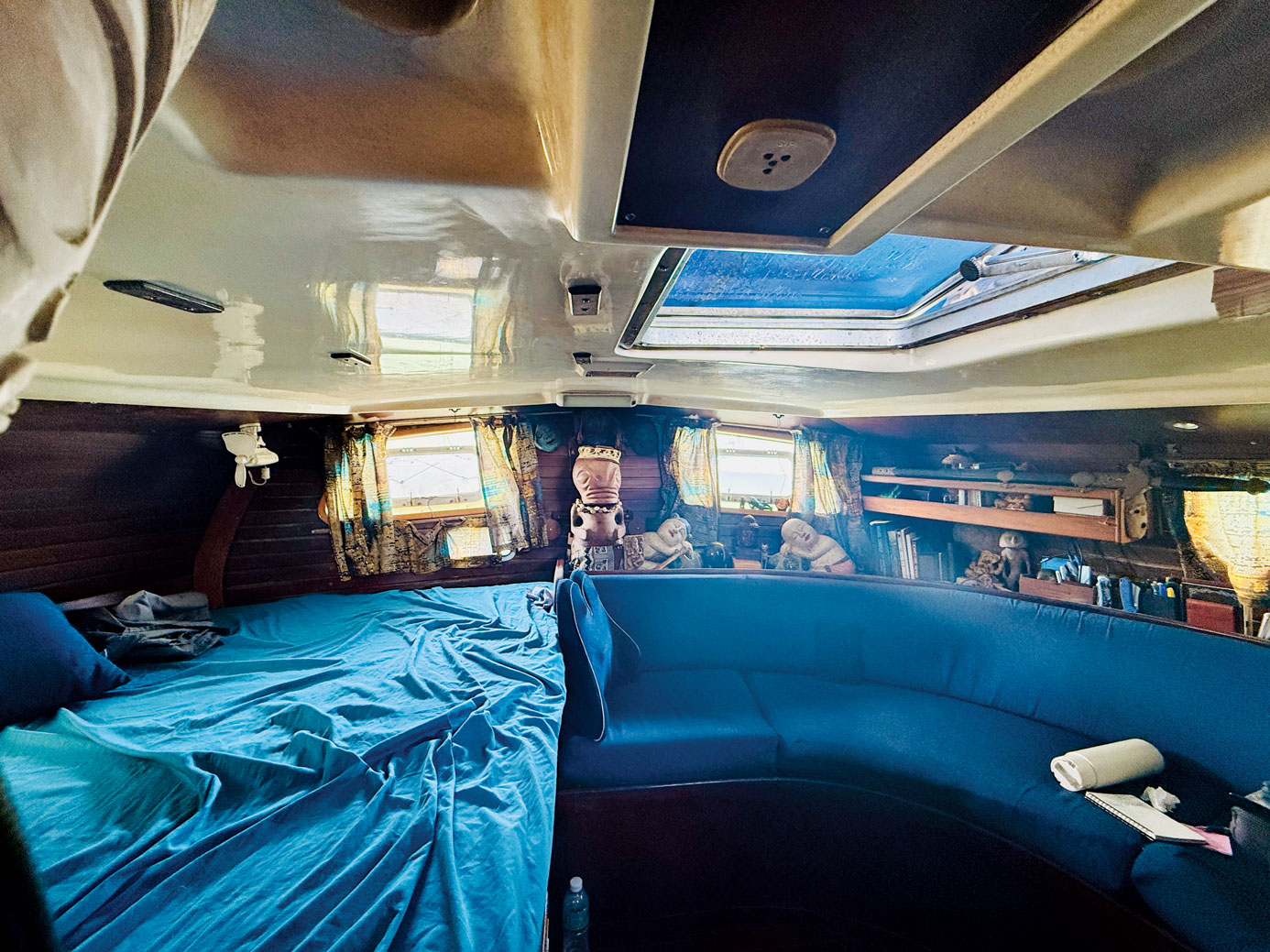
When I’m in this aft cabin—which I am a lot since I write for four hours per day there—I’m amazed that I have a boat with such a well-thought-out, precisely-engineered interior.
This aft cabin-slash-office was the whole reason I purchased this particular boat.
But everything on a boat has a cost, every detail is a trade-off.
How did they manage to leave out the mizzen chainplates? By making the aft deck super thick. Or, to put it another way—by making the aft deck super heavy. In fact, the entire design is, because of the aft cabin, extremely heavy aft… which tends to increase hobby-horsing (violent fore and aft rocking). Plus, the weight is up high—another bad place for it. This further reduces the stability of the vessel and, alas, the righting moment of the design.
Also, I have nowhere to store my fenders offshore. Ditto, my twin propane tanks, docklines, mops, dive gear, bottom scrapers, emergency safety equipment, etc. Thus, the previous owner built two giant 2-foot high, 1.5-foot wide, 3-foot long fiberglass saddles bags on each side of the boat. These not only are above the deck but outboard of it too! Thus, in order not to have them scraped off while docking, rafting, or being boarded by the Coasties, they both have stainless-steel protectors built around them.
What does a boat with a heavy deck, massively heavy overhead liner, and too much freeboard need? That’s right—more weight above deck level!
See the trade-off? Do I love my aft cabin while sleeping, working and lounging inside it? Yes! Do I love my aft cabin while on deck in heavy weather? Not so much.
For example, to cram all this crap into it, the aft head sink is far outboard and thus firehoses saltwater everywhere while on port tack in a gale (or even just hove-to).
That’s bad.
Please note that all-of-the-above is the fault of the designer, builder, and previous owner—not me. But perhaps stupidity is contagious because, when I joined into the madness, I joined in with gusto!
The cabin, with eight large glass openings, has a green house effect. It’s hot in the tropics and I live at one-degree North latitude.
Hmmm…
I am a man of action—so, WTH, I took a saw to the twin aft cabin windows—and chopped a place in the Lexan for two gigantic opening ports.
How clever was that? Viva yo! The cabin immediately felt ten degrees cooler—it was like getting air-conditioning, mon!
Obviously, chopping holes in my hull was tiring—so my wife and I went to sleep early.
Now, Serangoon Harbor isn’t crowded. And it’s very cheap. Why? Because some of the largest ships in the world roar by… mere yards (well, meters) away. This means that we often roll from rail to rail from their massive, curling, roaring wakes. So what? I scrambled my brains in the ‘60s—why complain about breaking waves hitting us beam-on every 15 minutes or so?
I’m an internationally famous masochist—isn’t that a requirement for being a serial circumnavigator?
Did I mention the strong current that keeps us (mostly) pointing parallel to the freighter traffic?
Of course, tidal currents do reverse—and just at the wrong moment, while Ganesh was sideways to the racetrack channel and its transom pointed at it, a super tanker roared by at full-tilt-boogie.
The wave that came through my newly-installed, 8-inch by 14-inch openings was like… like a tsunami! It drenched both of us with saltwater, surfed us forward into the bulkhead—and drowned our mattress, sheets, and pillowcases too!
“…what, we have to sleep with snorkels now?” my wife asked in amazement.
Oops.
Have I done stupider things? Maybe. So, I needed to redeem myself ASAP.
The following day, I rushed to the store and came back with two large plastic cutting boards—and drilled a bunch of holes around their edges.
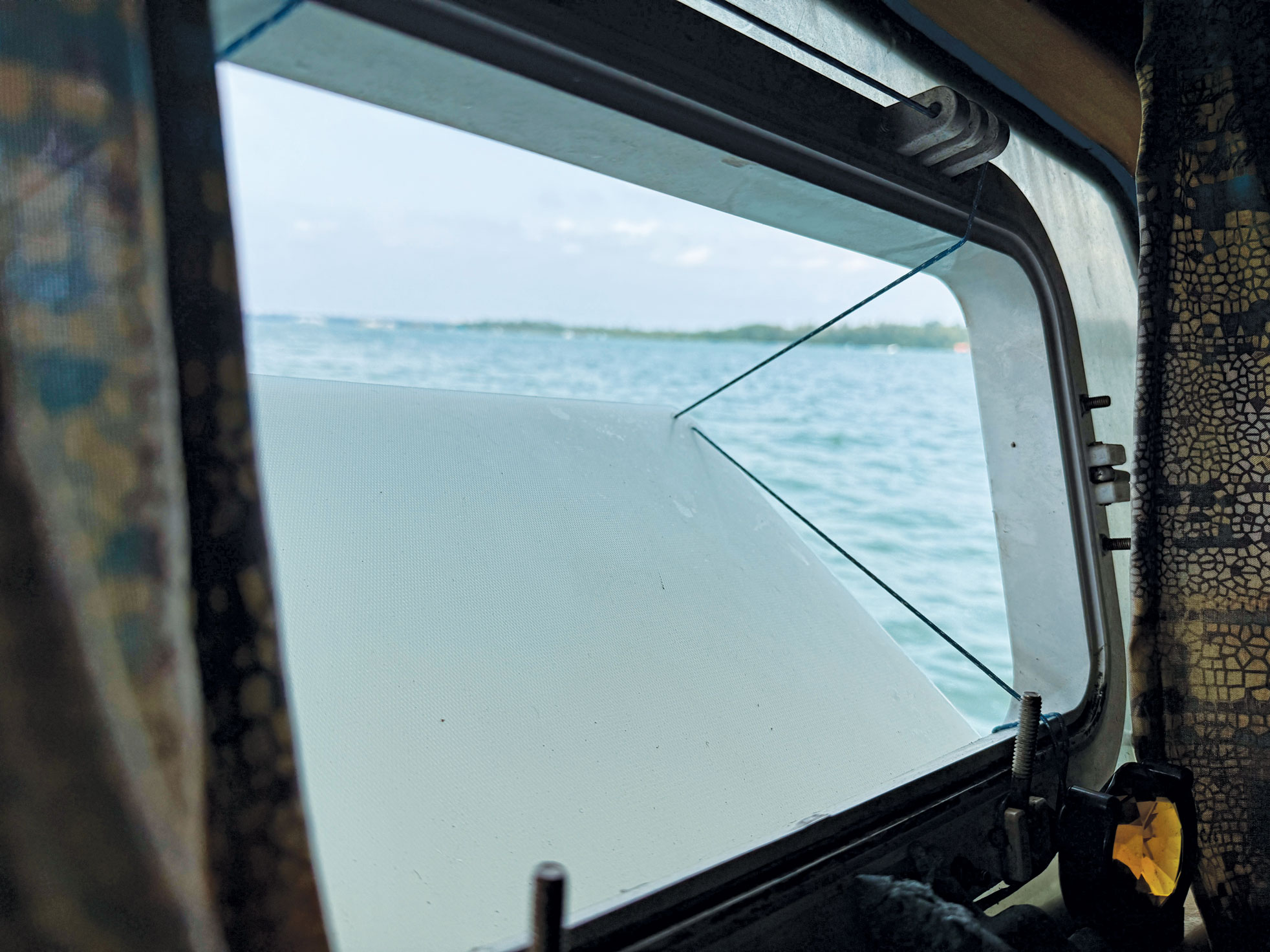
Now when a massive sea attempts to drown us in our sleep—the oddly-protruding cutting boards slam shut on their Kevlar strings—and nary a drop enters.
“…hey, babe,” I tell the still-angry wifey, “It is all a trade-off, right?”
Yes, it’s the things you don’t see when looking at a new boat that are vitally important.
For instance, I’m a tad old fashioned. I believe that keels should stay attached. Sure, I use Velcro and love 3M’s 5200… but for keel attachment? Really?
And, yes, I don’t mind my ensign flapping around… but my keel? I mean, sailing with a keel slatting this way-and-that depending on tack? I know, I know, I should be able to get used to vessels spitting off their keels at about the same rate as their skipper’s divorce but…
Since the hulls of many modern boats have all the rigidity of a toy balloon—designers have taken to bolting the keels to keel grids inside the boat to spread the load.
This works well until the dock hugger is abused—by, say, a risk-loving, foolish owner who wants to sail his sailboat outside the breakwater. All that wiggling makes the keep bolts seat-and-reseat into the soft, mushy fiberglass… and eventually spit off the keel.
…plus, these keel grids add weight and take-up space—so most builders aren’t interested.
I mean—why not discard backstays, lower shrouds, and chainplates? Why not keep the rig all lousy-goosy? Doesn’t a wise skipper return to the marina if the wind gusts over eight knots?
Plus, the advantages of Velcro-attached bulkheads (to prevent oil canning) is that the bulkhead locations can be changeable—one place for the skipper during a Wednesday race, and another one for his wife’s annual cocktail party!
Do you know why modern multihulls seldom have kerosene lamps? Because their smoke bells are in the wrong position when they’re upside down!
I raced on a Hunter once. It was strange to be on a hull that was weaker than my morals!
In Bali I was on a cattlemaran owned by some rich brat with too much money, too much Peruvian coke, and a sink full of rancid dishes. The only thing keeping that decrepit vessel from sinking was the roaches holding hands. That’s right! She had more leaks than the White House, more holes than a spaghetti strainer!
At another point I was delivering a popular 65-foot monohull (with a jacuzzi aft to attract the charter trade) from the East Coast to St. Thomas. It kept spitting out the centerboard with amazing regularity. When we complained to the builder, he shouted with great exasperation, “We don’t build boats to sail through storms!”
Ah, well… that makes sense.
I love the new, blue toothed electrical systems on boats that are controlled by your iPhone. These vessels are particularly advantageous during wartime bombings—one drop of salt, and the entire boat blacks-out.
…have you seen these new OLED cockpit-wide nav displays and entertainment centers? I mean, why not watch PornHub while club racing?
…in-mast furling? I mean, aren’t they inherently safer when the sail is jammed in? Why does the media only focus on their being jammed out? Not fair!
Folding transom platforms are fun. The boats that have them sell like hotcakes, especially if the owner has kids. However, they add weight aft. In the down position, they are extremely fragile—even a powerboat wake or moderate sea can damage one. Ditto if something (like a stray sheet or piece of diving gear) gets jammed in them while they’re being folded. In the Med they seldom last more than a few weeks as they’re used to step ashore while Med Moored—and thus get crushed between boat and seawall when the wind comes up.
One tap, and they’re toast.
…as much as I’m ashamed to admit it, I laughed when I walked by a half-million-dollar boat with the gigantic folding transom platform held onto the vessel with two flimsy aluminum hinges and six short self-tapping panhead screws!
Let’s put it another way—there are limits to shoddy work, and that particular builder didn’t have a clue where they were!
The lifespan of such a piece of gear might be measured in hours, not months or years.
Part of the attraction of cattlemarans are their dinghy hoists. I recently helped a friend take delivery of a 47-footer far north of a million bucks—a vessel made in South Africa. The cables on its super-convenient ‘push button’ hoisting cables were severely kinked during the delivery—and only ‘kinda’ worked for a few days… which is, according to a number of owners, their average life span. (Six months later, the yard was still claiming that all their units failed from operator error, not poor engineering and improper cable/sheeve specs.)
Of course, if your elderly grandparents own a cruising boat that you’d like to inherit sooner rather than later—just give them an extremely powerful pair of electric sheet winches with an unprotected button that is easily switched on—whether intentional or not. If they’re forgetful or a tiny bit daft—this combo will quickly put them (and some of their deck gear) in the hospital pronto.
Oh, how ‘convenient’ those one-hundred-zillion-watt winches are—to call back into the cockpit for the jib to be trimmed, trimmed, and trimmed some more—only to hear a loud bang as the stowed, furled-on-deck staysail is savagely torn in half!
I know, I know—I’m super cheap and hopelessly old fashioned. For example, during the last 66 years of living aboard, sailing, and serial circumnavigating… I’ve never owned a self-tailing winch.
…they’re too posh (portside out, starboard side home).
…aging sailors with empty pockets need to look at the Big Picture—a lifetime of undersized manual sheet winches equals no Viagra at age seventy!
My point isn’t to advise you, dear reader, on what gear to buy—but rather to remind you that everything afloat is a compromise and has a price. And it is no fun to end up aboard a boat whose owner has too much money and not enough sense.
(Fatty and Carolyn continue to live and love in Southeast Asia.)
Cap'n Fatty Goodlander has written for ALL AT SEA since 2005.
Goes straight to Fatty. ALL AT SEA takes nothing.
Worth your time?
Thanks — noted.