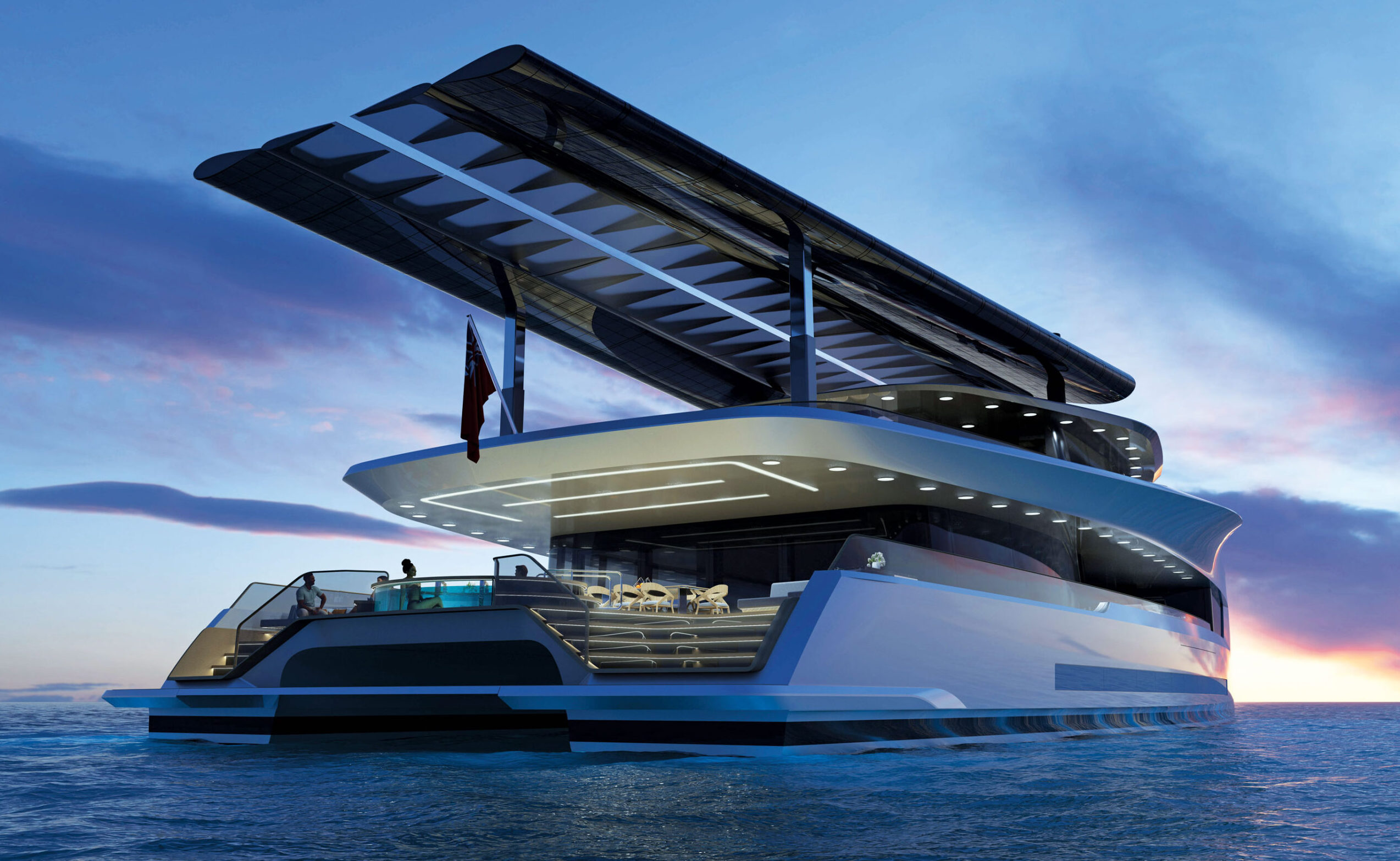
Project Dragonfly: Perfect for the Caribbean
Dixon Yacht Design’s Project Dragonfly combines wing-sail technology, sustainable systems, and catamaran stability in a groundbreaking superyacht concept.

A revolutionary sailing catamaran concept from Dixon Yacht Design is reimagining what a luxury cruising yacht can be.
Known as Project Dragonfly, the innovative sail-assist catamaran combines advanced wing-sail technology, sustainable engineering, and expansive living spaces in a platform designed for global exploration—including the Caribbean.
“She would be a perfect vehicle to enjoy the Caribbean,” says Anders Berg, partner and principal naval architect at Dixon Yacht Design. “With her vast beam equal to a 100-meter monohull, she promises remarkable space and stability for island cruising, combining comfort, innovation, and sustainability in one striking platform.”
A Different Approach to Sailing Performance
At just under 500 gross tons, Project Dragonfly was conceived as a sail-assist catamaran featuring cutting-edge Aero Wing Sails developed by Rondal.
Unlike conventional sails, the rigid wing structures:
- Rotate through 360 degrees
- Feature adjustable camber through multiple flaps
- Can furl horizontally during severe weather
- Tilt dramatically to reduce air draft
One of Dragonfly’s most remarkable capabilities is reducing air draft to less than 40 feet, allowing access to shallow anchorages, bridges, and protected harbors often unavailable to vessels of comparable size.
Designed for Caribbean Cruising
Dixon collaborated with Michael Leach Design to create a layout focused on both luxury and practicality.
Key features include:
- Expansive open-plan living spaces
- Seamless connection between the saloon and beach club areas
- Hidden tender storage amidships
- Flexible owner’s suite or dual VIP cabin configuration
- Four additional guest cabins
- Dedicated crew accommodations
The catamaran’s beam creates interior volume comparable to much larger monohulls while maintaining the stability and shallow-draft advantages multihulls are known for.
Built Around Sustainability
Environmental performance is central to Dragonfly’s design.
The concept incorporates:
- Partially recycled aluminum construction
- Integrated solar panels
- Solar-generating wing structures
- Propeller energy recovery systems
- Reduced reliance on fossil-fuel propulsion
These technologies are intended to lower operating costs while reducing environmental impact during long-range cruising.
What This Means for the Future of Sailing Yachts
Project Dragonfly reflects several emerging trends in large-yacht design:
- Alternative propulsion systems
- Increased energy self-sufficiency
- Sail-assisted efficiency
- Greater emphasis on sustainability
- Enhanced access to remote destinations
As fuel efficiency and environmental responsibility become increasingly important, concepts like Dragonfly may help shape the next generation of long-range luxury cruising yachts.
Carol Bareuther has written for ALL AT SEA since 2004.
Worth your time?
Thanks — noted.