Martinique’s Yoles Rondes: The Traditional Boat Racing Festival You Can’t Miss

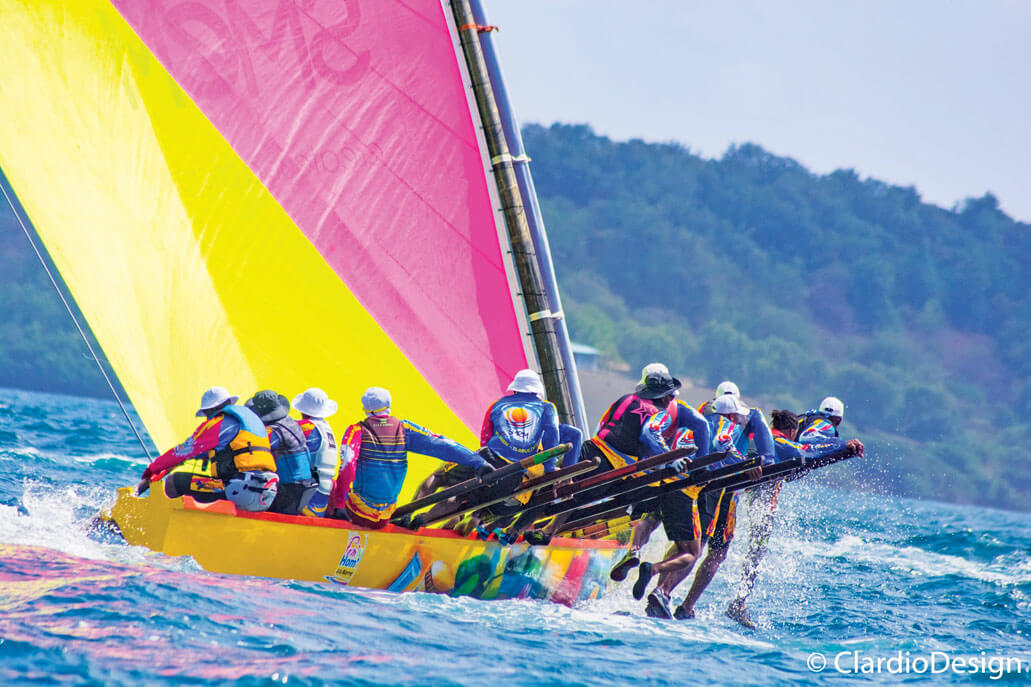
For one solid week each summer, the entire island of Martinique participates in one of the best annual nautical events – the Tour des Yoles Rondes. This sees the French Caribbean island’s traditional yole boat, officially listed in UNESCO’s Register of Good Practices for Safeguarding Intangible Cultural Heritage since 2020, race by sea from town to town with crowds of onlookers, music, food, and drink at each stop. The Tour des Yoles Rondes is a unique-to-Martinique, nearly four-decade-long festive celebration that keeps the yole and its maritime history alive for locals and visitors alike. It’s no wonder. The yole’s history, construction, and racing is fascinating.
A Centuries Old Start
It’s the combination of different seafaring techniques, from the first indigenous navigators to modern times, which has contributed, on one hand, to the gradual development of a uniquely shaped vessel and, on the other, to sailing practices specific to this type of boat. In general, the yole’s beginning dates to the 17th century.

The Martinican yole is original and multiethnic, with key elements of the island’s cultural identity,” says Philippe Jean-Alexis, president of the association, Femmes et Hommes à la Barre (Men and Women of the Bar), who, with Tania Marcellus, organize group sessions to experience traditional yole sailing for journalists and travel agents at the request of the Martinique Tourism Committee. This association was a pioneer in promoting women’s inclusion in competitive yole sailing. “The history of the yole is closely tied to the lives of fishermen. Initially, the yole was a highly practical vessel that allowed them to store their equipment and move around. Fishing was once a widespread activity in coastal towns, known as ‘sous le vent” (leeward). It was often the sole means of subsistence for many families. Almost everyone knew a fisherman in their community, and many people depended on this trade. To navigate the waters, fishermen relied on the yole.”
The transition of the yole from utility purposes to sport began when fishermen spontaneously organized friendly competitions, where the first to reach the beach won the race. This competition generated such enthusiasm that local mayors began organizing official competitions during town festivals. While new construction rules were introduced, it remained true to its traditional origins. A purely Martinican creation, the yole ronde is now considered a true work of art. Today, Yole ronde racing is practiced exclusively in Martinique, primarily in Atlantic coastal towns such as Le François, Le Robert, La Trinité, Le Vauclin, Le Marin, Sainte-Anne, and Le Diamant. However, Caribbean-side towns also hold races, including Fort-de-France, Schoelcher, and Saint-Pierre. However, a yole ronde once successfully crossed the English Channel from England to France.
The Construction
The yole ronde is classified as a ‘light’ vessel—without ballast, keel, or rudder. It has a shallow draft and can be equipped with one or two sails. It is built by Martinican marine carpenters, specialists in traditional construction, repair, and restoration of wooden yoles and associated materials. They are the ones who assemble and fit the ribs, secure the planks to the wooden frame, and adapt the yole for regattas. In most cases, the marine carpenter is also a fisherman.
Specifically, tells Jean-Alexis, “A yole is built by assembling planks, or ‘bordés,’ horizontally fixed to a framework made of ribs. Strip-planking is not allowed.
The framework, assembled first, consists of the main structure, the stem, foucas’ (wooden ribs), additional ribs, and the stern board. The planks used, usually pearwood or cedar, must be made from solid wood with a single thickness between 6- to 8-inches. While ideally a single piece, planks may be grafted to achieve the required lengths. They are fitted edge-to-edge. A ‘sabot’ (wooden shoe) is mounted at the center ribs, like those at the bow, to hold the base of the main sail’s mast.”
The Fédération des Yoles Rondes de Martinique (FYRM) has set official length requirements for competition yoles: 34.5 feet for a standard yole, 20.6 feet for a baby yole, and 13 feet for a mini yole.
Yoles have several essential accessories. There’s a ‘false mast,’ a wooden piece added to the front of the yole to support the main mast that carries the foresail. The ‘tet pagay’ or paddle head is a T-shaped wooden piece that helps maneuver the paddle. The ‘bois dresses’ are small tresses used to stabilize the yole. The ‘bois bouline’ or ‘va-et-vient’ is a solid wooden piece that may be fixed or adjustable, while the tolé is a small wooden block used for securing the bois dressés and sheets, and the ‘tête de chien’ is the top point of the stem or bow.
Yole Sailing & Crew Roles
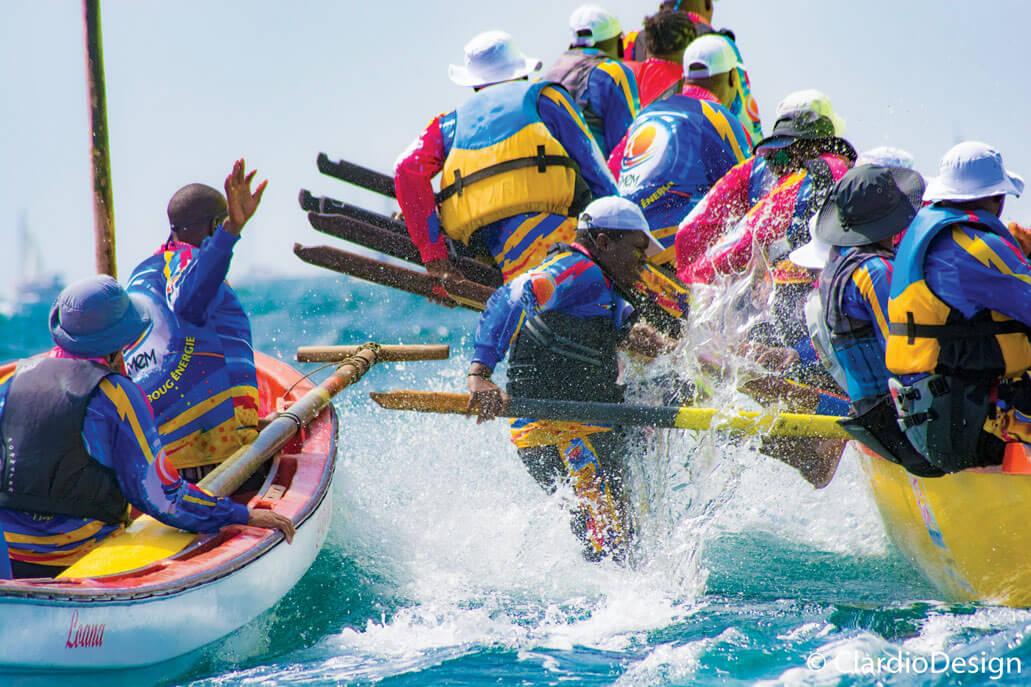
Yole sailing in Martinique is strictly an amateur activity, says Jean-Alexis. “The ‘patron’ is the sole master on board, like a ship’s captain. He decides crew members’ number, placement, sail selection, and yole maneuvering during regattas and training. He has extensive experience, knowledge of the waters, and an understanding of the trade winds. One or two paddle operators may assist him. The patron communicates effectively with his team and sometimes performs additional tasks beyond his own.”
Then there are the ‘aide-patrons’ or assistant captains who help manage the paddle based on natural elements and race strategy. There are usually one or two aide-patrons. The ‘manœuvrier d’écoute’ or sheet handler is responsible for the sail’s control lines. He adjusts the sail’s tension in coordination with the patron’s decisions.
The ‘bois dressés’ or balancing crew members stabilize the yole. Their number can reach up to ten. They counterbalance the wind force on the sails using wooden poles; to do so, they must be agile. Depending on wind strength, they adjust their position along the wooden lever: the stronger the wind, the further out they extend, and when the wind weakens, they move closer to the yole for balance. Among them, two have especially crucial roles: The ‘first balancer’ is positioned at the front and serves as the patron’s eyes, signaling wind gusts, obstacles, and the location of competing yoles. The ‘last balancer’ remains in place during tack maneuvers and is the last to switch sides with its balancing pole.
Festive Events
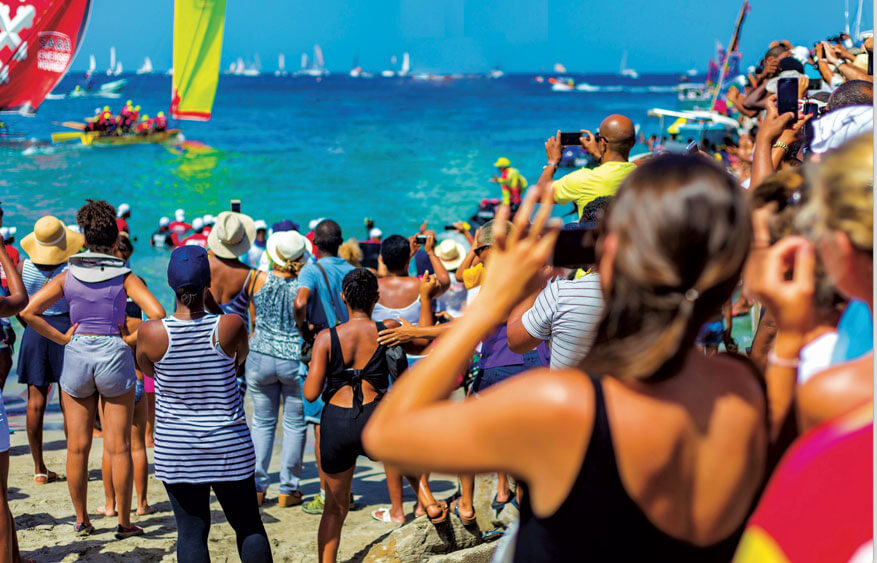
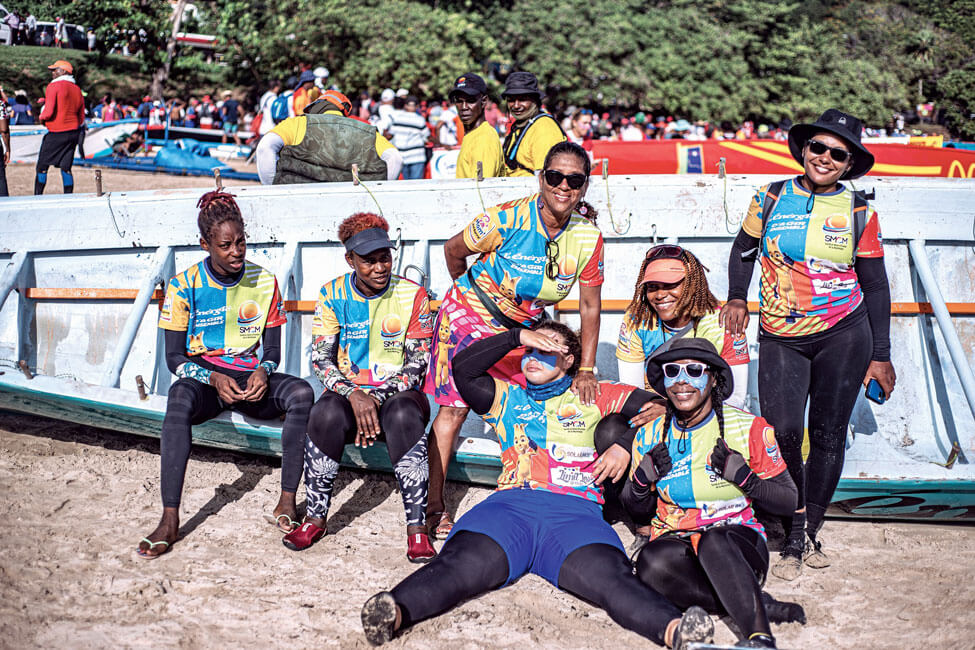
Martinicans follow yole ronde regattas with passion and pride, especially those held in Le Marin, Le François, and Le Robert. These races are highly spectacular.
The Federation organizes several competitions each year, including The Championship (Challenge), the May 22nd Challenge, the Tour de la Martinique, and the Martinique Cup. Around twenty yole ronde races occur annually, half of which involve baby yoles.
About ten yoles participate in the Tour des Yoles Rondes every year. This year, the event will take place from July 27 to August 3, 2025.
“This event is a major sporting and cultural highlight in Martinique, consisting of up to seven stages around the island,” says Jean-Alexis. “Tradition and performance combine to delight the public, who travel hundreds of kilometers to witness the race. Aware of this cultural treasure, Martinicans turn out in massive numbers to support the yoleurs, especially during the Tour des Yoles Rondes.”
Carol Bareuther has written for ALL AT SEA since 2004.
Worth your time?
Thanks — noted.