




Deep-Sea Discoveries off Trinidad and Tobago: 20 Suspected New Species
A Trinbagonian-led team mapped 4,376 square miles of seafloor nobody had seen and came back with 20 suspected new species.

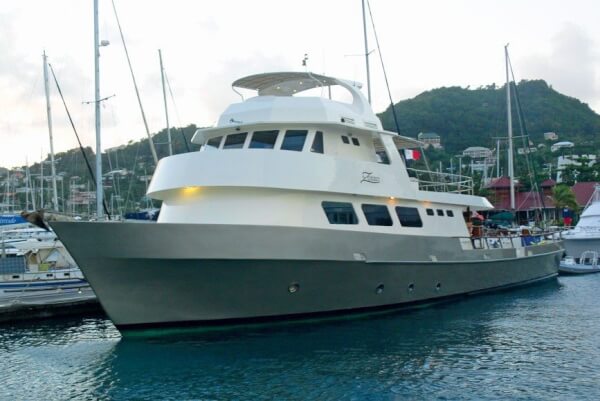
Less than 0.001% of Trinidad and Tobago’s deep-ocean territory has ever been explored. Now, scientists have found at least 20 suspected new species and 25 cold-seep or vent ecosystems in these largely unseen waters. The finds came during a month-long expedition in July, the first locally led comprehensive survey of Trinidad and Tobago’s deep sea, according to an August press release from Schmidt Ocean Institute. Aboard the Institute’s 363-foot research vessel Falkor (too), a team led largely by Trinbagonian scientists mapped 4,376 square miles of previously uncharted seafloor, about 13% of the country’s marine territory.

| Dates | June 29 – July 28, 2026 (28 days) |
| Vessel | R/V Falkor (too), Schmidt Ocean Institute, 363 ft |
| ROV | SuBastian |
| Seafloor mapped | 4,376 sq mi (11,335 km²), about 13% of the country’s waters |
| Cold seeps confirmed | 25, found by following 219 bubble streams |
| Suspected new species | 20, three possibly new genera |
| Species new to T&T waters | 54 |
| Specimens collected | 700+, to the Zoology Museum, UWI St. Augustine |
| Chief scientist | Dr. Diva Amon, SpeSeas |
Using the ROV SuBastian, scientists spotted ghost sharks, zombie worms and a black swallower fish, whose expandable stomach lets it eat prey larger than itself. They also encountered a rare manta ray fall at 3,363 feet. At least 54 species had never before been observed in Trinidad and Tobago’s waters.

Among the suspected new species is a Graneledone octopus first spotted in 2014 but not confirmed until this expedition. More than 700 specimens were collected.
The 28-day voyage, from June 29 to July 28, brought together SpeSeas, the University of the West Indies at St. Augustine and the Institute of Marine Affairs, with partners from Florida Atlantic University’s Harbor Branch, Dalhousie University and Spain’s national natural-science museum. The team followed 219 bubble streams rising from the seafloor to find the seeps; the largest covered half an acre in mussels and tubeworms. The 700 specimens are headed for the Zoology Museum at UWI St. Augustine, where they increase its deep-sea collection twelve-fold. Tissue from more than 86 species of sponges, corals and sea cucumbers was cryopreserved, the first “frozen zoo” in the Caribbean, and more than 2,000 people followed the dives through the Institute’s Ship-to-Shore program.

“These discoveries are proof that Caribbean scientists can uncover our own deep-sea backyard,” said Dr. Diva Amon, the Trinbagonian marine biologist and SpeSeas co-director who served as chief scientist on the expedition. “Every discovery we make, whether ecosystem, species, or behavior, deepens our understanding of what’s at stake and strengthens our ability to be true stewards of this unseen yet critical part of our country.” schmidtocean.org
For sailors who know Trinidad mainly as a hurricane-season haul-out, the numbers put the country’s water in a new light: 93 percent of it lies below recreational diving depth. Amon says the mapping and biology will feed marine spatial planning, including the establishment of marine protected areas. The team also found human-made trash on the bottom, a reminder that even the least-visited places carry a footprint.
Carol Bareuther has written for ALL AT SEA since 2004.
Worth your time?
Thanks — noted.