Lessons from Racing a Beach Cat: The Journey of Team Catitude
Follow the highs and lows of racing a Prindle 19 as two sailors navigate rough weather, near disasters, and the thrill of competition. A story of resilience, camaraderie, and adventure.

It seemed like a good idea at the time. I missed racing, so when I found out a Prindle 19 was for sale, I was thrilled. This was a race boat I could afford! So what if I had never raced a beach catamaran before? I had plenty of experience sailing other boats—I could learn.
Finding a Racing Partner
The next step was finding a racing partner. I hadn’t known Louri Lynn for long, but we got along well, and I knew she had some sailing experience. When I asked her if she wanted to race with me, she enthusiastically said, “Yes!”
With the boat purchase came Prindle-handling lessons, starting with rigging. We practiced every evening, drawing a growing happy-hour audience. Among them were a couple of seasoned beach-cat sailors, who occasionally chimed in with advice.
One evening, just before our first practice sail, Louri Lynn casually mentioned:
“I don’t actually know how to sail.”
I was stunned. She went on to explain that she had been on a beach cat once, but had never actually sailed one. Looking back, I realized I had never asked if she knew how to sail—only if she wanted to race. Still, she was eager, and we got along well. Teaming up seemed like a good idea at the time.
Rough Waters Ahead
Despite a near capsize on our first sail, we quickly gained confidence. But the real challenge came on the morning of our first solo practice session.
As we rigged the boat, I walked down to the water to assess the bay.
Louri Lynn joined me. “Are you figuring out how we’ll dodge the moored boats to reach open water?”
“No,” I replied. “I’m wondering if we’ll even be able to get off the beach.”
She laughed—until she realized I wasn’t kidding.
The conditions were rough, but the boat was rigged, and we were determined. It seemed like a good idea at the time.
We rolled Catitude down the sand and tried to drag her through the surf. Refusing help, we insisted that if we couldn’t launch her ourselves, we had no business sailing her.
Prophetic words, as it turned out.
After 30 minutes of struggling with 400 pounds of boat, we were exhausted. We dragged Catitude back above the surf line and staggered into the club for a break.
Five minutes later, a squall hit.
We couldn’t even see the boat through the downpour.
“Maybe we should forget sailing today,” Louri Lynn suggested.
“Good idea,” I admitted.
We had been so determined to launch that we had ignored the deteriorating weather. Luckily, we got away with being reckless. Lesson learned.
Survival Sailing and Sinking Boats
Our practice conditions were consistently miserable. If the weather was bad, we sailed.
- Louri Lynn trapped out so aggressively that waves regularly slammed her across the boat.
- A normally easy reach to the BVI turned into a brutal three-hour slog to weather.
- We devoured sailing books and picked the brains of experienced racers.
We had one goal: to compete in the Rolex Regatta—a major Caribbean race—in just three months.
The morning of our first race, we faced moderate but manageable conditions. As we sailed toward the starting line, something felt off. The helm was sluggish, and tacking became nearly impossible.
The problem worsened, so we headed back to shore. Dragging Catitude onto the beach was a struggle—she felt unusually heavy.
Then, as we removed the drain plugs, water gushed out of the hulls.
Catitude had been sinking.
Lesson two: Make a launch checklist.
Item one: Insert drain plugs.
The Rolex Regatta: A Test of Resilience
Despite our questionable level of preparedness, we entered the Rolex Regatta.
Day 1:
- We took forever to reach the racecourse, starting well behind our class.
- By the time we returned to the yacht club, only our family and friends remained onshore.
- Their cheers were less about our performance and more about the fact that we survived the day.
Day 2:
- We stayed upright through dense rain and gusty winds, thanks to our survival-sailing experience.
- A gybe went horribly wrong—Louri Lynn was gone.
- Her trapeze line had snapped, throwing her overboard.
- After hauling her back on board, we discovered our rudder system was failing.
- With no steering control, we had to retire from the race.
Day 3:
- I was too sick to sail. Catitude never left the beach.
- Our Rolex Regatta was officially over.
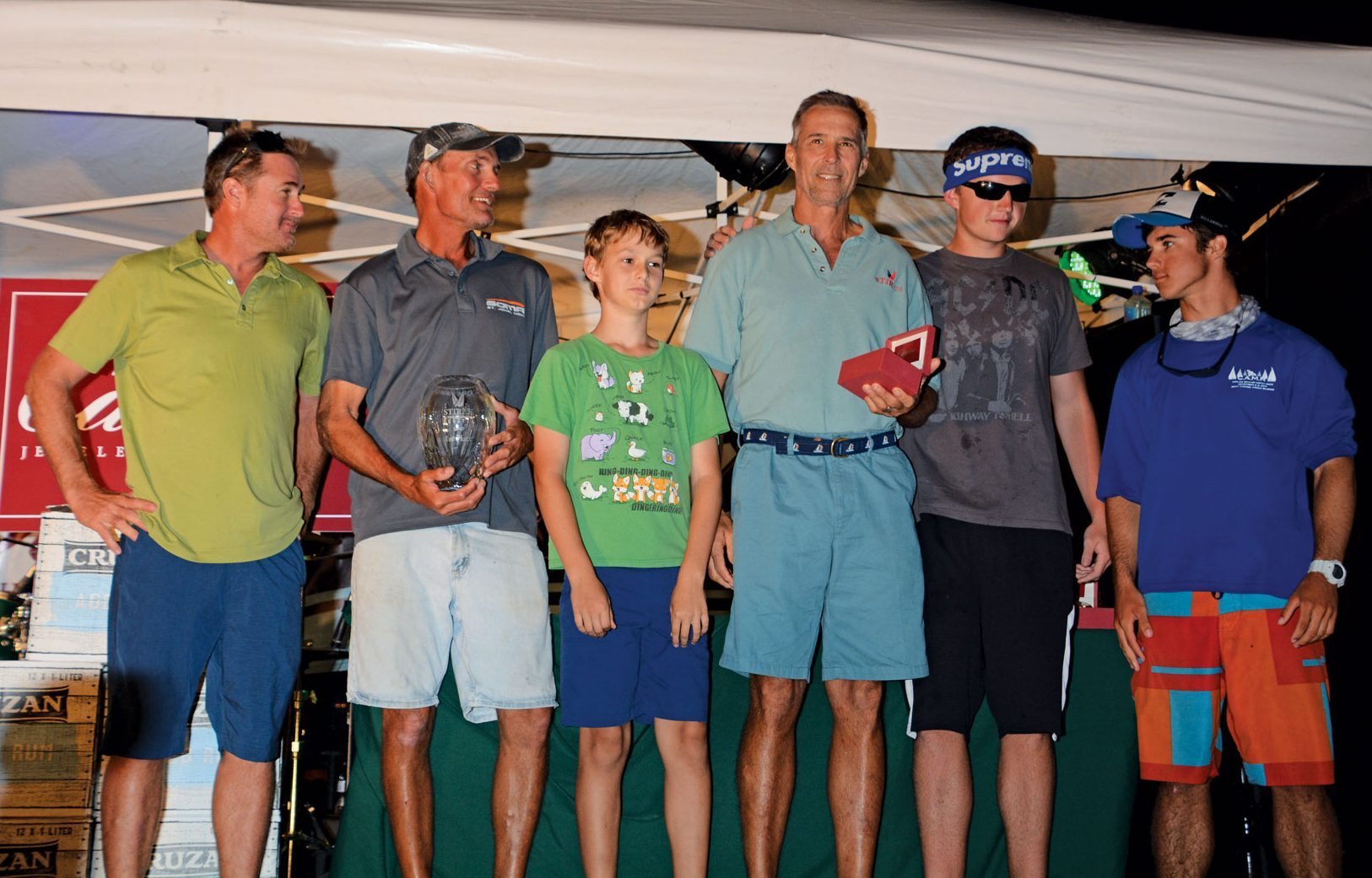
At the awards banquet, we learned that one other beach-cat team had placed behind us—because they had partied all weekend instead of racing.
We weren’t DFL (Dead F*ing Last).**
We had met our team goal.
The End of an Era
We had no regrets, but our racing journey was cut short.
- Three months later, I stepped into a hole and wrecked my ankle.
- Three years post-surgery, I had to accept that I would never race Catitude again.
I hated to let her go, but I couldn’t watch her rot in dry dock.
A New Chapter for Catitude
I sold her to two women from St. John. With the help of Morgan Avery, they transformed her into a power cat.
Today, Catitude sails with navy blue hulls, looking as jaunty as ever.
I’m happy she’s still on the water, but I miss racing her.
Final Thoughts: The Camaraderie of Racing
The beach-cat sailing community welcomed us with open arms—despite our rookie status. On and off the course, the camaraderie was second to none.
Racing a beach cat with Louri Lynn had been a great idea—even if it didn’t always seem like it at the time.
J. Summer Westman has written for ALL AT SEA since 2005.
Worth your time?
Thanks — noted.