



Living the Cruising Dream: Lessons from Alaska Jim and Backwards Bernie
From daring voyages to hilarious mishaps, Captain Fatty shares tales of Alaska Jim and Backwards Bernie—two unconventional sailors who prove you don't need wealth to live your cruising dreams.

As I flip through ALL AT SEA, a publication I first started writing for nearly 30 years ago, I realize how far cruising vessels have come.
I started out aboard a wooden vessel built in 1924. It had solid wood masts, galvy-rigging, and Egyptian cotton sails (which my father sewed on a treadle sewing machine on a dock in Pensacola, Florida).
Its foredeck anchor windlass was manual—as was its primary pitcher-deck pump with its six-foot-long iron handle. Its stove was a coal-fired Shipmate. Its primary light source was kerosene—for the simple reason that marine electrics weren’t dependable enough in the 1950s.

Our depth meter consisted of a sounding lead on a long line. It had a hollow part on its bottom so that it could be ‘armed’ with wax to bring up a sample of the bottom—basically, the same dependable system that James Cook used in the 1700s. (“Throwing the lead” is an art we’ll leave for another column.)
Our nav equipment consisted of a chip-log to measure speed, a vernier sextant (which is still in my family), a gimballed compass for steering, an Astro compass to adjust that steering compass, and a Polaris for taking bearings.
The Alden-designed Elizabeth also had one tiny six-volt battery and a 25-horse gasoline auxiliary engine that ran whenever it wanted—which wasn’t often.
Yes, we liveaboards have come a long way. Life is more convenient now. However, we happily cruised Elizabeth as a six-member family for over a decade.
This poses the question: What does a cruising boat need today that Josh Slocum or Magellan didn’t have yesterday?
Why do I ask this? Not because I don’t like modern boats. I do. I like ‘em! A lot! In fact, trodding the decks of a new Hallberg Rassy makes me weep with joy.
That’s right—when I started out there wasn’t a single production (affordable) sailboat designed to circumnavigate. Now there are dozens, the majority of which are worth every penny.
BUT… only if you have that penny.
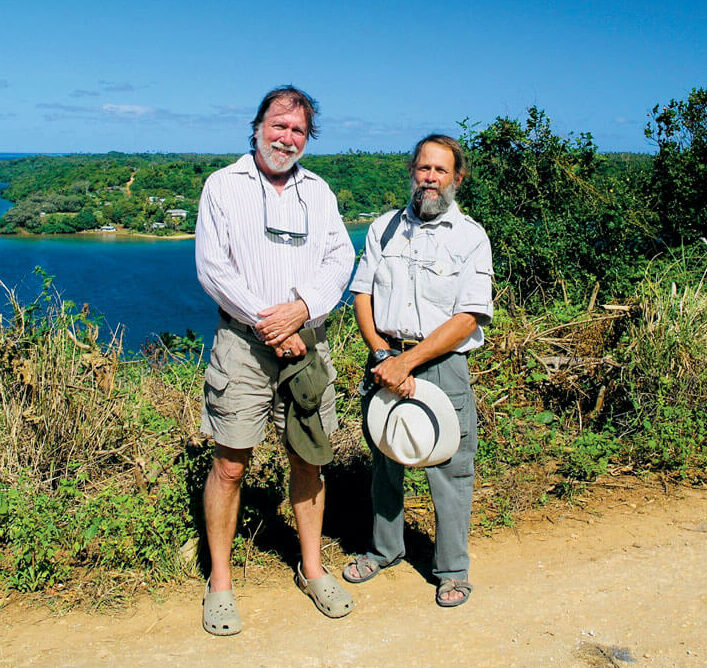
Since I’ve lived aboard barefoot all my life (well, 64 years of my 72 year), I’ve had very few pennies and yet have sailed hundreds of thousands of miles offshore during the course of our four circs and numerous ocean crossings.
How?
One way I’ve managed to sail so much on so little is to firmly keep in mind what a sailboat is: It is a container of air pushed by the wind. As far as survival goes, that’s it. As long as water doesn’t displace the air, it is in a seaworthy condition at that moment.
I’m not talking about efficiency, comfort, nor windward ability—just surviving until seeing the dawn.
Here’s another bedrock truth: Ease is a false god.
The idea that we cruisers should all have multi-million-dollar, air-conditioned yachts to live-aboard—sophisticated yachts equipped with fast, powerful dinghies to bring us to fancy air-conditioned yacht clubs with parking lots full of shiny, air-conditioned gas guzzlers so we can wait in traffic to get to an air-conditioned gym to use its rowing machine while watching a video on an expansive OLED screen showing a film about global warming… is utterly, totally, freak’n absurd, IMHO.
Oars work. They really do. Ditto, manual sheet winches. Manual davits. Hand and foot-operated sink pumps.
I’ve never owned a self-tailing sheet winch in my life!
…and probably never will.
I repeat, I’ve never needed a boat with air-conditioning because I’ve made all my vessels seaworthy enough to carry me to anchorages with cooling, frangipani-scented breezes.
I’ve not only lived aboard 64 years—but the vast majority of those years have been on my own hook or, occasionally, a mooring.
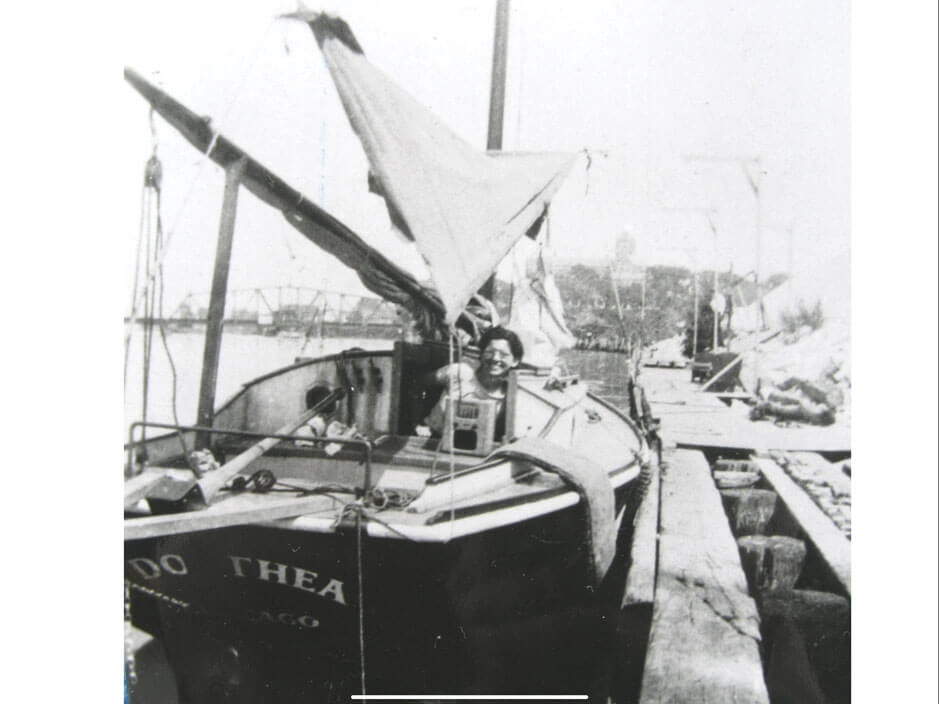
Why? Because living on the hook affords me the highest quality of life.
Wait—you can’t live on the hook where you live? Then move, dude—THAT IS WHAT WE CRUISING SAILORS DO! We’re one-trick-ponies. We move to ever-better, ever higher quality living conditions. That’s right, we constantly improve our lot and our location in life.
I currently swing on a mooring in plain view of six million people—and don’t lock my vessel. Or my dinghy. Or my bike.
I’ll never forget coming ashore at dusk in Polynesia and, as our inflatable approached the Kauehi beach, a dozen muscular teenage males rushed at us, violently grabbed the dinghy—and carried us (and our dinghy with its full gas tank and 2 hp outboard) onto land—then politely asked where we’d like to be brought to.
Yes, Polynesia has its dangers—for instance, we complimented a Pandanus-mat maker on her lovely year-long weaving project in her living room; and we were horrified to have her immediately order her husband to put the mat in our dinghy. (We saved face by informing her that we couldn’t fit her magnificent creation into our boat—our loss.)
The truth of it is, that each and every country we’ve visited in the last 57 years of active cruising—has had important things to teach us. Yes, my culture has things to teach others, as well—about the same amount of useful information that they have to teach us.
Yin and yang.
On my first day in Vanuatu, I thought Chief Ronnie was dumb as a rock because he lived in a mud hut and didn’t own shoes. But two months later I realized that he was one of the wisest, most remarkable leaders I’ve ever met.
But here’s the truth of it. You don’t need a floating pimp-mobile with twin satellite balls to meet these folks. To learn from them. To enjoy their company. In fact, glitzy makes it more difficult, not less.
What’s the difference between a battered-but-seaworthy Westsail 32 and a tricked-out, multi-million dollar layer cake with an eight-foot-wide sliding patio door? I’ll tell you what the difference is—one is far, far more seaworthy than the other.
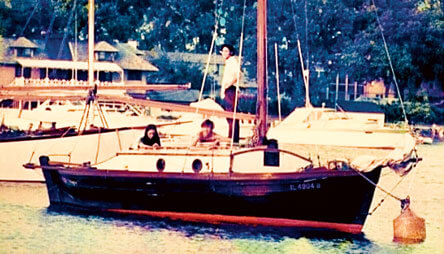
…one consistently rescues the other.
…one will sail you and your family safely around the world on pennies—and the other will sail from FedEx office to FedEx office to wait for parts.
The good news, however, is this—it’s your choice. We live in a free world and everyone is allowed to factor in seamanship and glitz in different measures, depending on experience.
What’s seamanship? Seamanship is, at its most basic, learning at sea. Yes, experience counts. And experience can’t be found on YouTube—no matter how many Bikini-clad butts you click on.
Choose carefully. What do you want to be, a voyager or a voyeur?
Here’s something that, in my humble opinion based upon my experience as a world-wide cruising sailor, is absolutely true.
Let’s say there are 20 boats in a tropical harbor, split between a modern marina and an ancient anchorage once used by Ulysses. The ten boats that have all the conveniences—gen/set, air-con, electro-dinghy-davits, etc—will all be plugged into the dock; and all the boats without any of those conveniences will be in the anchorage… having book exchanges, trading charts, and having sundowners together.
Wanna be happy at sea? Ask yourself this question. Which is more important to you—to live on a boat with a Starlink internet connection to learn about whales—or anchor for a month or two at Conception Reef amidst actual live whales calving.
It’s your choice. I choose Conception. And I happily penned a book while there, listening to the whales singing through my hull.
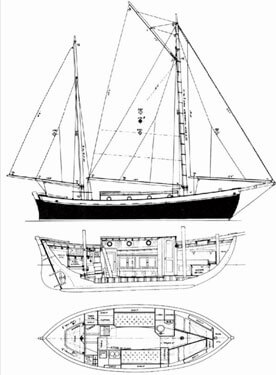
PS. Oh, I forgot to mention that one of these choices is far, far more economical than the other.
If you own a car, a pair of dress shoes, and drive to work in Europe or America—I’d be surprised if you can’t be anchored in Paradise in a ‘couple of three’ years if you put your mind to it.
Doubt me? Just ask Alaska Jim. He was broke and living above the Arctic Circle—surviving by hunting and fur-trade. He’d read this magazine by flashlight inside his sleeping bag each night—and laugh his butt off at my stories. One day he decided—why not me? He sold everything, flew to New Zealand, purchased a rust bucket of a boat, anchored it alongside Wild Card, our $3,000 Hughes 38, in the Bay of Islands.
“Howdy!” he said, with a wild, crazy grin, “Where do we head to next, skipper?”
Horrified that he’d never stepped on a sailboat before, didn’t even KNOW HOW TO SWIM, and was stalking me—I silently fled to Tonga, nearly a thousand miles away, before the next dawn. It took him months to find me—but Alaska Jim was fiercely determined to be a sea gypsy, just like me.
When we did meet again, he wasn’t discouraged about averaging 60-some miles a day—only that he had no dependable running lights. So, on a tiny island in the middle of nowhere, I took a crowbar and pried one of my solar cells off my cabin top.
“I can’t accept that,” Alaska Jim said.
I replied, “Jim, if every day I pried another $500 piece of gear off my deck for a solid year; I’d have barely scratched the surface of all the stuff I’ve been given by my fellow sailors. Don’t mention it—this lifestyle isn’t about money, it’s about seamanship, with a dash of joy.”
Jim now has about… I dunno… 15,000 to 25,000 sea miles under his belt at this point? And he now thinks nothing of sailing across an ocean—the Indian or the Atlantic, no problem! As a matter of fact, you can tell when he’s gonna do so because he lowers himself into the water to clean his hull with a fat rope around his waist because… well, swimming still isn’t Jim’s strong point.
Is Alaska Jim nuts? Probably. But he’s happy nuts, and that’s saying something in this modern, about-to-boil world of ours.
Take Backwards Bernie as another example. At some point in his travels around America, he met an Aussie gal who was a good kisser.
She returned home and he promised to visit ASAP.
Backwards Bernie was a crackerjack mechanic. He soon salvaged a John Hanna-designed Tahiti ketch with a blown engine from the boneyard of a shipyard in Michigan. As soon as he got the engine running—he set off for Sidney via the Mississippi River.
Alas, pulling into Chicago, he blew its ancient transmission—and it took every last penny to buy the parts to rebuild it.
Twice more in the Illinois River the trany failed. Then, just coming out of the Starve Rock locks, Backwards Bernie (a big, burly guy) cursed mightily as the boat coasted into the river bank, unbolted the trany, and deep-sixed it with a satisfying splash.
Oh, Bernie was a decisive dude, I’ll tell ya!
Tying the boat to a tree—he went in search of a welder and a short piece of pipe. It didn’t take him long to find assistance—as Bernie was persuasive.
With the welding truck idling on the river bank, Bernie welded a section of pipe in place of the trany. His plan was simple—start the engine when he wanted to go and shut it off when he wanted to stop. Transmissions were for sissies, right?
As the bewildered guy in the welding truck waved away Backwards Bernie’s last dollar—Bernie pushed off the bank and cranked up.
One problem.
The boat went backwards
“Thank gosh Tahiti ketches are double-enders,” he said to cover his surprise.
On the other hand—WTH, why be fussy with minor details, right?
Now, steering a double-ender backwards at full speed with an outboard rudder isn’t easy—it takes a very strong, very focused, very determined man.
…luckily, Bernie was determined. That Aussie broad could kiss!
After Memphis, the fixed bridge heights were such that Bernie was able to put up his twin masts—and thought he was in heaven! I mean, sailing is so freak’n easy! And the winds were strong and the river wide—and he was making (with the current) 12 knots frontwards!
Now, Bernie had never really sailed before and his boat didn’t have any blocks or other expensive gear, so he had trouble controlling her when the river narrowed.
In fact, he sailed her right into seawall at full-tilt boogie, as he later called it. This snapped off his bowsprit and took both masts down. But wait, it gets worse!
Some workers, unused to sailing vessels, saw his vessel go under the bow of a large barge tied to the very same seawall and get pinned there—and thus they went to rescue him in their crew boat.
…which immediately wrapped some of Bernie’s floating rig in its propeller. And soon two vessels and two masts and one broken bowsprit were trapped under the sloping bow of that rusty barge, held there by the full force of the Mississippi current.
Dang!
…so soon it was back to backwards powering for Backwards Bernie!
Now I caught sight of him while having a beer at the Porthole Bar in West End, Lake Pontchartrain (NOLA). His dismasted vessel, as it slowly powered by my window backwards, looked like it had been hit by a nuclear weapon.
Immediately, I knew we were going to be friends—that Backwards Bernie was my kind of sailor!
“…but how will you find Australia?” I said, running down the shore as he muttered about the kissing technique Downunder.
He seemed confused.
“I’ll just follow the Gulf Marine map, like I’ve done thus far on the river. The Gulf Marine maps at the fuel docks are free, you know.”
Thus, I set about teaching Bernie celestial navigation—a real challenge, believe me. Carolyn even taught him a few phrases in Spanish, so he could ask for directions when he finally got to the Yucatan on the way to the Panama Canal.
Six months later, with me still trying to teach him the difference between variation and deviation (the non-marine one was a small magazine distributed by Penthouse at the time)—Bernie set off for Australia. Alas, I must have goofed up my instructions because a month later he sailed up on Clearwater Beach and attempted to speak Spanish to the bewildered Floridians.
“Wanna sell her?” asked a guy on the beach, watching the ketch pounding in the surf.
“Nope,” said Backwards Bernie, “but I’ll trade her for a one-way airplane ticket to Sydney!”
Was Backwards Bernie even nuts-ee-er than Alaska Jim? You betcha! But Jim just finished cruising the East Coast and is now back in Dutch St. Maarten. And Bernie still drops me a lipstick-smeared note once and a while—says that those Aussie kisses are as sweet as ever.
My point is this. We’re adults. We have choices. And we can act on those choices—there’s nothing stopping us from living our dreams.
Were Jim and Bernie’s choices wise?
They think so—and who better to ask?
Cap'n Fatty Goodlander has written for ALL AT SEA since 2005.
Worth your time?
Thanks — noted.
Ha! Great story!